Fake jewellery: what a buyer should check — hallmark, fineness, certificate and deal rules
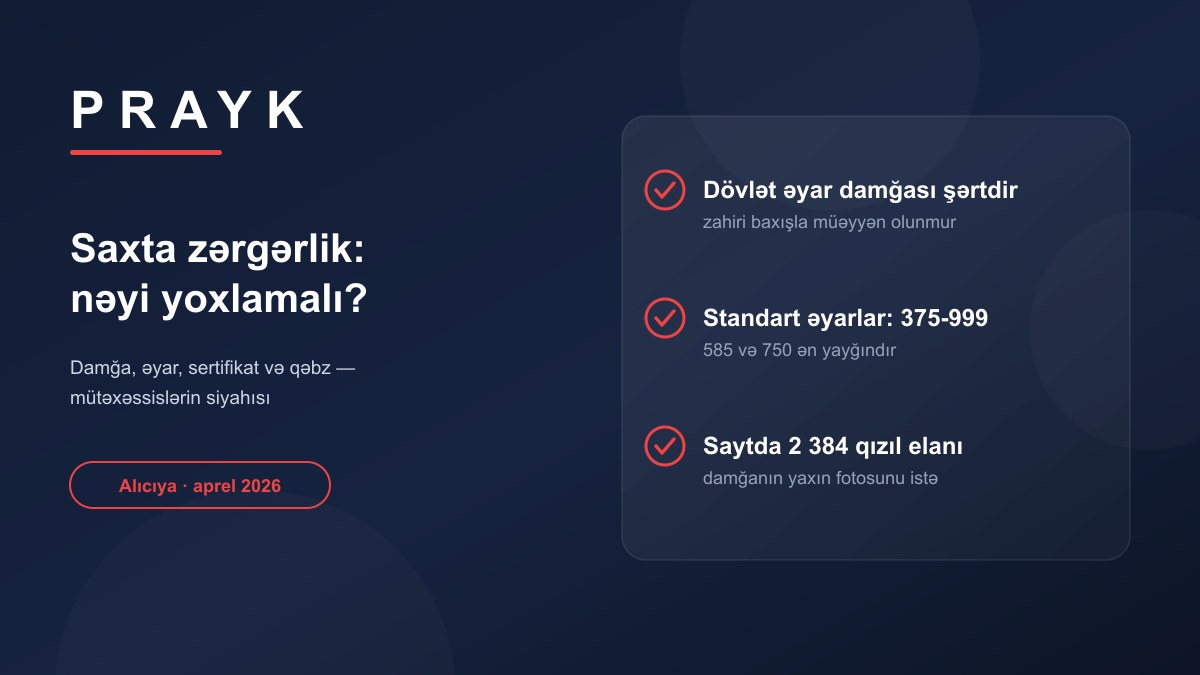
The more valuable gold becomes as an investment, the higher the risk of fraud around it. In material published by navigator.az citing the newspaper Kaspi, specialists explain what a buyer can verify.
What the specialists advise
- The state hallmark. According to Rovshan Amirjanov, deputy chairman of the board of the Azerbaijan Jewellers Association, the law requires jewellery produced and offered for sale in the country to carry a state assay hallmark — its presence is one of the key conditions.
- Standard finenesses. The standard finenesses set for gold are 375, 500, 583, 585, 750, 958 and 999. If the stated fineness is not on that list, that is the first warning sign.
- You cannot tell by eye. Professional testing uses X-ray fluorescence (XRF), cupellation (fire assay) where needed, and sometimes laboratory methods such as ICP-OES and AAS.
- Documents and a receipt. If the piece contains a precious stone, ask for an expert document or certificate stating its type, weight and characteristics; a receipt and clearly stated exchange and return terms matter too.
- The most common scheme is passing off a lower-fineness item as a higher one, along with misinformation about weight and stones.
Aynura Galandarova, who works in the gold trade, adds that because the world price changes daily, comparing several sources before buying helps both to value the piece correctly and to reduce risk; if in doubt, the item can be tested where laser equipment is available.
Extra rules when buying through a listing
The material names as riskiest exactly those sales where origin, receipt, fineness confirmation and certificate are unclear. On Prayk keyword search finds 2,384 published listings related to gold and jewellery (12 September 2026), and the same rules apply here:
- Ask for photos — a close-up of the hallmark and the fineness number is the simplest first filter.
- Compare the price — an offer far below the market average is the most common trap; look at similar listings in the Goods section.
- Meet in a safe place, ideally where the piece can be tested; do not transfer a deposit or advance.
- Keep the correspondence — the account-security rules and seller badges help you decide.
Source: navigator.az, 19 April 2026.