Wood-burning stove for the home: types, sizing and safety
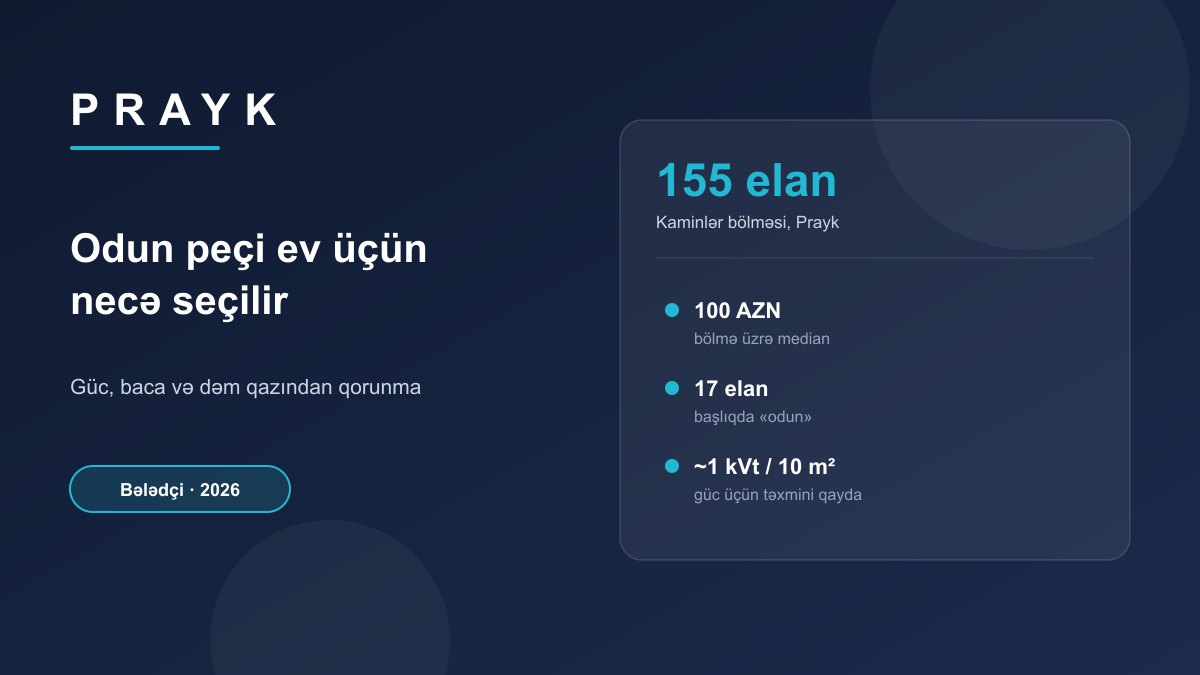
Three questions decide which wood-burning stove to buy for your home: how many square metres it has to heat, which type (basic sheet-metal, heavy closed stove, masonry, or one with a water jacket) fits the way you will use it, and whether a safe chimney can be installed. A rough rule: with 2.5–2.7 m ceilings and average insulation, allow about 1 kW for every 10 m², and up to 1.5 kW in an old, draughty house. The chimney matters even more than the stove — a stove with poor draught is a risk of both fire and carbon monoxide poisoning.
Short answer: as of 22 September 2026, Prayk's Fireplaces section has 155 listings with a median price of 100 AZN (half at 70–138 AZN), but most of them are decorative gas heaters. In the Heating Systems section only 17 listings have «odun» (firewood) in the title (median 40 AZN, half at 25–120 AZN) — mostly basic metal and used stoves. When looking for a wood stove, filter by section and the word «odun».
Types of wood-burning stove: which one suits you?
| Type | How it works | Pros | Cons | Best for |
|---|---|---|---|---|
| Basic metal stove (thin steel) | Combustion air is barely adjustable | Cheap, heats up fast, light | Cools quickly, burns a lot of wood, body gets very hot | Garage, workshop, occasionally used country house |
| Closed stove with thick steel or cast-iron body | Tight door; secondary air also burns the smoke gases | Long burn, less wood and smoke, visible flame | More expensive; door seal needs periodic replacement | Permanently lived-in home, main heat source |
| Masonry (brick) stove | Heavy mass stores heat and releases it for hours | Even, long-lasting warmth | Heavy, needs a foundation, slow to heat, a job for a mason | Private house still under construction |
| Cooking stove | Cast-iron hob on top, sometimes an oven | Heating and cooking in one | Overheats the room in warm months | Village house, summer kitchen |
| Stove with water jacket | Water jacket feeds hot water to radiators | Heats several rooms | Needs an expansion tank, safety valve and professional installation | Private house with radiators |
| Open fireplace | Open hearth, smoke straight up the flue | Looks, atmosphere | Most heat goes up the chimney; draws air out of the room | Decor and extra warmth |
Sizing by room area: how many kW do you need?
A stove's data sheet lists its nominal output (kW) and often the «heated area». Compare your area with this rough table: average insulation — about 1 kW per 10 m²; an old, poorly insulated house — about 1.5 kW.
| Heated area | Average insulation | Poor insulation |
|---|---|---|
| 20 m² | ≈2 kW | ≈3 kW |
| 40 m² | ≈4 kW | ≈6 kW |
| 60 m² | ≈6 kW | ≈9 kW |
| 80 m² | ≈8 kW | ≈12 kW |
| 100 m² | ≈10 kW | ≈15 kW |
Two mistakes are common. The first is buying a stove that is too big «just in case»: once the room is warm, people close the air control and let the fire smoulder, and that smoky burn deposits tar (creosote) in the chimney — a leading cause of chimney fires. The US Environmental Protection Agency (EPA) also notes that for most appliances a smouldering fire is neither safe nor efficient. The second is trying to heat a whole house with one stove: it mainly heats the room it stands in, and warmth reaches other rooms only through open doors or via a water jacket.
Wood stoves and fireplaces on Prayk: listings and prices
| Selection | Listings | Median | Middle half of listings |
|---|---|---|---|
| Fireplaces section, all | 155 | 100 AZN | 70–138 AZN |
| Heating Systems, «peç» (stove) in title | 75 | 95 AZN | 60–125 AZN |
| Heating Systems, «odun» (firewood) in title | 17 | 40 AZN | 25–120 AZN |
Despite its name, the Fireplaces section consists mostly of decorative gas «şömine» heaters; 72 of the 75 listings with «peç» in the title are also here, and most are used gas stoves. Wood-burning stoves are scarce: the 17 listings are mainly basic metal and used stoves plus some accessories, and modern closed stoves appear only occasionally (for example, one seller offers a modern wood stove for 80–150 m² homes at 300 AZN). Of the fireplace listings, 82 are in Baku, 28 in Digah, 11 in Masazir and 8 in Khirdalan.
To search, open Fireplaces or the whole Heating Systems section and type «odun». The choice is limited right now, so set up a search agent to hear about new listings straight away. If the stove will be your only heat source, compare it with a combi boiler too.
Safety: chimney, fire and carbon monoxide
Chimney
- The chimney must be intact and sealed; where it passes through the ceiling and roof, use a non-combustible insulated passage (for example, a double-wall insulated pipe).
- Never reduce the flue outlet diameter — it must match the stove manufacturer's specification.
- The chimney should rise above the roof ridge so wind does not push smoke back down; the exact height is in the manufacturer's instructions and building rules.
- Have the chimney swept and inspected before every season — tar and bird nests spoil the draught. For installation and sweeping, see the masters section.
Fire protection
- Stand the stove on a non-combustible base (metal sheet, tiles, stone) that extends in front of the door — embers can fall out.
- Keep at least the clearance to walls and furniture given in the manufacturer's instructions; keep curtains, furniture, newspapers and books away from the stove.
- Store ashes in a covered metal container outdoors on a non-combustible surface — ashes can hold live embers for a long time.
- Never start a fire with petrol, kerosene or lighter fluid, and keep a fire extinguisher handy.
Carbon monoxide
Carbon monoxide is colourless and odourless — you cannot sense it. The most dangerous habit is closing the flue damper while embers are still glowing «to keep the heat in». Close the damper only when the fire is completely out, install a carbon monoxide (CO) detector in the stove room and bedroom, and keep a fresh-air supply. If several people get a headache, dizziness, nausea or drowsiness at the same time, leave the room for fresh air immediately and call 103 (ambulance) or 112. Official fire-safety information is on the Ministry of Emergency Situations website.
Firewood: what to burn and what not to
- Dry wood only. The EPA recommends seasoning wood for at least 6 months; it burns best at a moisture content below 20%. Dry wood is lighter, darker, and sounds hollow when knocked against another piece.
- Proper storage. Keep wood off the ground and cover only the top — covering the sides traps moisture.
- Species. Hardwoods (oak, beech, mulberry, apricot, apple) burn long and leave good embers; resinous softwoods such as pine catch fast — good for kindling, but when damp they foul the chimney quickly.
- Do not burn: painted, varnished or chemically treated wood, chipboard, plywood, glued wood, plastic, rubber, cardboard or household waste — they give off toxic smoke and damage the stove.
If you cut your own firewood, see the chainsaws and electric saws section. Interestingly, a search for «odun» on Prayk mostly finds saws and log splitters rather than firewood itself — ready-cut firewood is rarely listed in the catalogue.
Checks when buying a used stove
- No burn-through holes, cracks or warping in the body — especially in the firebox and along welds.
- The door closes tightly, the rope seal is in place and the glass is not cracked.
- The grate and ash pan are intact.
- The damper and air controls move freely.
- The flue outlet diameter matches your chimney.
- A water-jacket stove shows no signs of leaks; have a plumber pressure-test it before installation.
- Do not convert a gas heater into a wood stove — its firebox and flue are designed for a different regime, and gas appliances must be connected only by an authorised gas service.
Stoves are heavy and transport is an extra cost, so look for a seller close to you on the nearby listings page.
Frequently asked questions
What size wood stove do I need for a 50 m² house?
By the rule of thumb, a house with average insulation needs about 1 kW per 10 m², so roughly 5 kW for 50 m²; an old, poorly insulated house needs 7–8 kW. Do not oversize the stove: a low, smouldering burn builds up tar in the chimney and raises the fire risk.
How much does a wood-burning stove cost?
As of 22 September 2026, Prayk's Heating Systems section has 17 listings with «odun» (firewood) in the title; the median price is 40 AZN (half at 25–120 AZN) because most are basic metal and used stoves. The 155 listings in the Fireplaces section have a median of 100 AZN, but they are mostly gas heaters.
How do I prevent carbon monoxide poisoning from a wood stove?
Have the chimney swept every season, close the damper only after the fire is completely out, keep a fresh-air supply and install a carbon monoxide detector in the stove room and bedroom. If you feel a headache, dizziness or nausea, get to fresh air at once and call 103 or 112.
Which firewood is most suitable for a stove?
Hardwood seasoned for at least 6 months with moisture below 20% — oak, beech, mulberry, apricot, apple. Resinous pine is fine for kindling but fouls the chimney quickly when damp. Never burn painted or varnished wood, chipboard, plywood or plastic.
Can I burn wood in a gas heater («şömine»)?
No. A gas appliance's burner, heat exchanger and flue are not designed for the temperature and soot of a wood fire; using it this way creates a risk of fire and carbon monoxide poisoning. Wood needs a wood-burning stove and a chimney that matches it.
Sources and methodology
Listing counts and prices were taken from Prayk's public API on 22 September 2026: the whole Fireplaces section, listings in the Heating Systems section (with all subsections) with «odun» and «peç» in the title, and a catalogue-wide search for «odun» (to gauge how much firewood is sold). The median and «middle half» (25th–75th percentiles) use only listings priced in AZN. The sizing table is a general engineering rule; for an exact heat-loss calculation, consult a specialist. On seasoning and storing wood and what not to burn: EPA Burn Wise; on fire safety: Ministry of Emergency Situations of the Republic of Azerbaijan.