Pletka (riding whip): types, choosing one and humane use
“Pletka” is the everyday word in Azerbaijan for a riding whip (from the Russian «плётка»). In equestrian sport it is not a tool for punishment but an artificial aid that reinforces the rider’s leg and seat. Which whip you need depends on the discipline: a short whip for jumping and hacking, a long whip for dressage, and a lunge whip for working a horse on the lunge line.
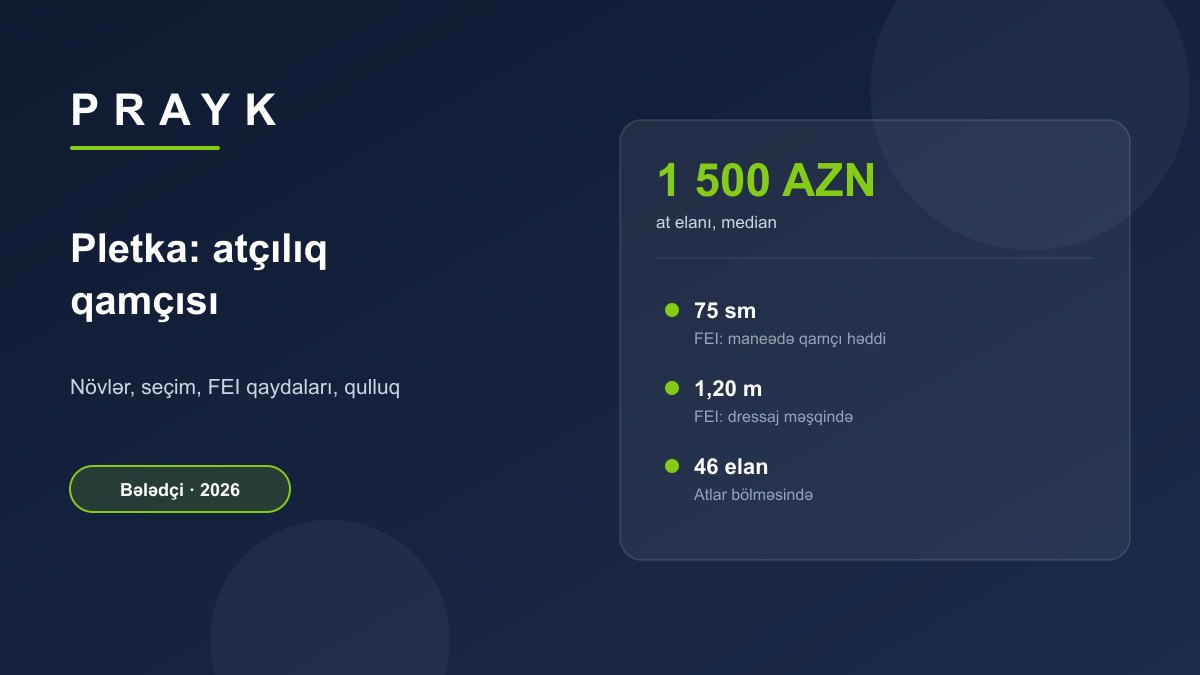
Short answer: a riding whip is there to clarify a signal, not to punish the horse. Under the International Equestrian Federation (FEI) requirements in force from 2026, in eventing a whip must be no longer than 75 cm when jumping obstacles and on cross-country, and no longer than 1.20 m (1 m for ponies) in the dressage practice area; carrying a whip into the arena at international dressage events is forbidden. On 22 September 2026, Prayk had 46 horse listings (median 1,500 AZN) but no listings with “pletka” in the title.
What is a riding whip for?
Communication with a horse runs mainly through the legs, seat and reins. The whip is an addition: if the horse ignores a leg aid, the rider repeats it with a light touch of the whip. The aim is not to cause pain but to make the signal clearer, so a whip’s value lies in precision rather than force.
- Where to touch: just behind the rider’s leg, on the horse’s side. The head, neck, belly and legs are off limits.
- When: immediately after the leg aid — a delayed touch becomes a meaningless punishment for the horse.
- How: short and light. Using the whip in anger or “to teach a lesson” is unethical and destroys the horse’s trust.
- With the reins: do not pull on the reins while using the whip, or the horse receives “go” and “stop” at the same time.
If you are a beginner, agree with your instructor when and how to use a whip. Many riders take their first lessons without one and only pick it up once their seat is secure.
What types of riding whips are there?
| Type | Length | Used for | Notes |
|---|---|---|---|
| Short riding whip (crop) | short; in FEI eventing max 75 cm over obstacles | Jumping, cross-country, hacking | Wide, soft keeper at the tip: the touch makes a sound rather than pain |
| Dressage whip | long; max 1.20 m in the FEI practice area (1 m for ponies) | Dressage training | Lets you touch the horse without taking your hand off the rein; forbidden in the arena at international dressage events |
| Lunge whip | long shaft and long lash | Working a horse on the lunge | Not for touching the horse but for directing and setting the pace from a distance |
| Driving whip | long | Carriage driving | Long because the driver cannot reach the horse’s side by hand |
| Show and decorative whips | long, braided leather | Performances, collections, interiors | Not for handling horses; when cracked, the tip moves extremely fast and can injure eyes and face |
What to look for when choosing one
- Length. It must suit the discipline and competition rules. If you plan to compete, check the current FEI or national federation rules — they are updated regularly.
- Keeper. A wide, soft keeper is preferable. The FEI eventing requirements for 2026 call for a padded, smooth whip with no weighted end on cross-country and in the jumping test, with a transition period until 1 January 2027.
- Grip. It should not slip in a gloved hand. A knob at the end of the handle keeps the whip from falling out of your hand.
- Balance and weight. A light, well-balanced whip does not tire the hand and lowers the risk of an accidental hard hit.
- Material. A synthetic core with nylon braiding stands up to rain and washing. Leather feels nicer in the hand but needs regular care.
Safety and ethics
- Law. Cruelty to animals is prohibited in Azerbaijan and carries liability. Check the current rules in the official legal database e-qanun.az; this article is not legal advice.
- Competition. A rider competing with a whip that does not meet FEI rules may be eliminated at the judges’ discretion. For national competition rules, contact the Equestrian Federation of the Republic of Azerbaijan.
- Children. A whip is not a toy. A child should only use a short riding whip under an instructor’s supervision.
- Show whips. Only learn to crack a long braided whip next to an experienced instructor, wearing safety glasses and away from people and animals. The tip moves so fast that a strike can cause serious injury.
- The horse’s reaction. A nervous horse, or one that has been mistreated before, may tense up at the mere sight of a whip. In such cases, decide on using a whip together with your instructor.
How to care for a riding whip
Wipe a leather whip with a damp cloth after each use, let it dry and treat it with leather balm from time to time so it does not crack. Store it hanging, away from direct sun and radiators, so it does not bend. A synthetic whip only needs washing with soapy water. Check the keeper regularly: a torn or hardened keeper forms a sharp edge and should be replaced.
What can you find on Prayk?
On 22 September 2026, the equestrian picture on Prayk looked like this:
| Metric | Value |
|---|---|
| Listings in the Horses section | 46 |
| Median horse price | 1,500 AZN (from 45 AZN listings) |
| Middle half of listings | 1,000–2,800 AZN |
| Locations | Baku 15, Kurdamir 6, Ismayilli 4, Ganja 3, Gusar 3 |
| Listings in the Saddles section | 0 |
| Listings with “pletka” in the title | 0 |
The figures show that horse listings are spread across the regions, while riding equipment rarely appears as a listing. If the whip or saddle you need is not there, post a request in the “Wanted” section — here is how it works: sellers see your request, and you get a notification when a matching listing appears. You can also check the Pet supplies section and use a saved search.
Frequently asked questions
What is a pletka?
“Pletka” is the everyday word for a riding whip used in equestrian sport. It is an artificial aid that reinforces the rider’s leg and seat. The main types are the short riding whip, the long dressage whip, the lunge whip and the driving whip; braided show whips are not meant for handling horses.
Does a riding whip hurt the horse?
Used correctly — a short, light touch on the side right after the leg aid — the aim is a clear signal, not pain. Hard, repeated or angry strikes harm the horse, count as cruelty and are penalised in competition.
What length of whip should I choose?
For jumping and cross-country, riders choose a short whip; the FEI eventing requirements for 2026 set a 75 cm limit when jumping obstacles. For dressage training a long whip is used, limited by FEI rules to 1.20 m, or 1 m for ponies. Always check the current rules before competing.
Can I buy a riding whip for a child?
For a child who takes riding lessons, buy a whip only on the instructor’s advice, and it is usually a short riding whip. Long show whips are not suitable for children: when cracked, the tip moves extremely fast and can injure eyes and face.
How do I care for a leather whip?
Wipe it with a damp cloth after each use, let it dry and treat it with leather balm from time to time. Store it hanging, away from sun and radiators, so it does not bend. Replace the keeper if it is torn or has hardened.
Sources and methodology
Whip lengths and usage rules come from International Equestrian Federation documents in force from 1 January 2026: the FEI tack and equipment requirements for dressage and the FEI tack and equipment requirements for eventing. National rules: araf.az. Prayk figures were taken on 22 September 2026 from the public listing feed of the catalogue: the Horses section (46 listings, all included; median and range from the 45 listings priced in AZN), the Saddles section (0 listings) and a title search for “pletka” (0 results). A listing price is the seller’s asking price. We do not give a price for whips themselves because there are no whip listings on Prayk.