Car insurance in Azerbaijan: compulsory motor liability vs KASKO
Car owners in Azerbaijan deal with two main types of insurance. Compulsory motor insurance (officially, compulsory insurance of the civil liability of vehicle owners) is required by law and pays for harm you cause to others: a pedestrian, a passenger, another car. KASKO is voluntary and covers damage to, theft of and other contract-listed risks for your own car. One does not replace the other: even with KASKO you still need the compulsory policy.
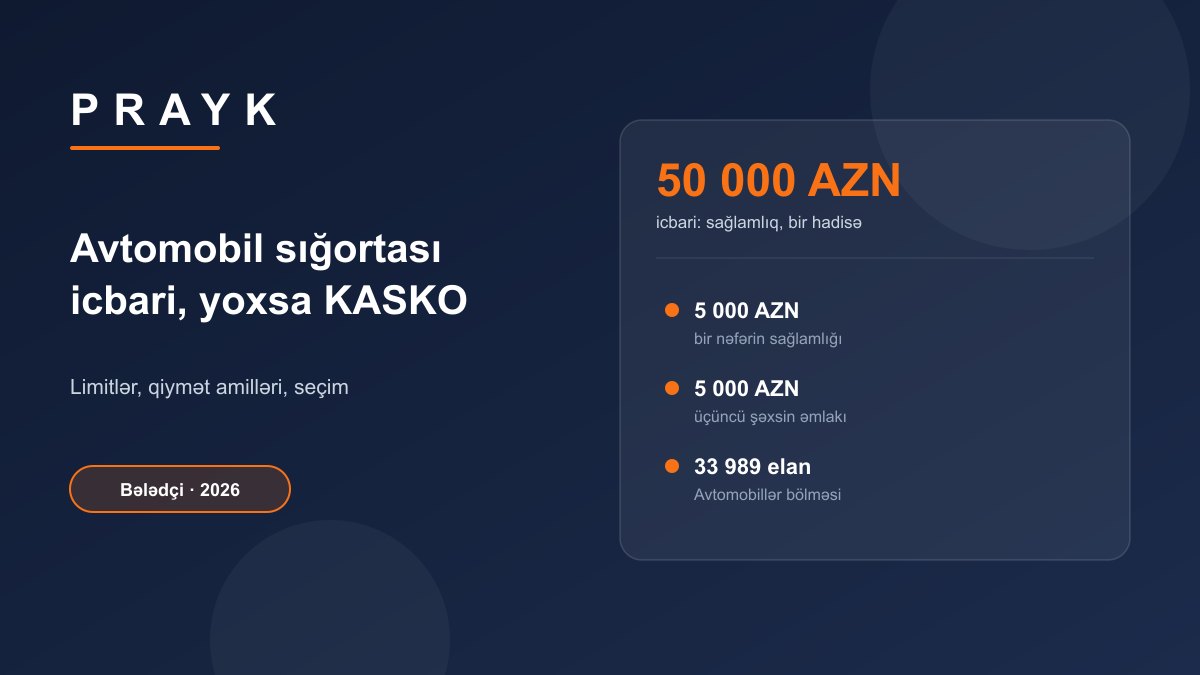
Short answer: a standard compulsory policy runs for 12 months and pays up to 5,000 AZN for harm to one person's health (no more than 50,000 AZN per incident) and 5,000 AZN for damage to third-party property. The Central Bank sets the premium calculation rules. KASKO price and terms are set by the insurer in the contract. As of 22 September 2026, the Cars section on Prayk has 33,989 listings; the median price of the latest 300 is 13,990 AZN.
Who must have compulsory motor insurance?
Under Article 50 of the Law on Compulsory Insurance, third-party liability insurance is mandatory for mechanical vehicles registered in Azerbaijan and for mopeds. According to the Compulsory Insurance Bureau, this covers all cars and motorcycles with an engine of 50 cm³ or more or a design speed above 50 km/h, trams and trolleybuses, tractors and farm machinery. The policy must be taken out by the owner or whoever lawfully operates the vehicle: a lessee, a driver with a power of attorney, a leasing customer.
- Who is covered: whoever the certificate is issued to, the liability of anyone lawfully driving the car is insured (Art. 53.4).
- Term: a standard policy lasts 12 months and, unless the certificate says otherwise, takes effect when concluded (Art. 55).
- Validity: a policy is valid only if concluded through, and recorded in, the information system (Art. 51.1). The system must let you confirm a policy online and via mobile (Art. 61.4).
- Borders and travel abroad: for Green Card countries you take out an "Azerbaijan Green Card", while a foreign car without a Green Card needs a border policy. Both run for 1, 3, 6 or 12 months (Art. 55); a one-month compulsory policy costs 20 percent of the annual premium (Art. 57.2).
Under Article 469.3 of the Code of Administrative Offences, an individual who fails to take out compulsory insurance is fined 50 AZN and must conclude a policy within 20 days; the offence can also be detected by photo and video cameras. The amount comes from the official text of the code — it may change, so check the current version.
What does compulsory insurance cover, and what not?
It pays for harm caused to others through the use of your car. Passengers in your car also count as third parties (Art. 54). If you caused the accident, repairs to your own car are not paid from the compulsory policy — that is what KASKO is for. The insured amounts are fixed in Article 56:
| Type of harm | Insured amount |
|---|---|
| Harm to one person's health | 5,000 AZN |
| Harm to health — total per incident | no more than 50,000 AZN |
| Damage to third-party property | 5,000 AZN |
These amounts do not shrink during the policy term, even after payouts (Art. 56.2). Damage above the limit is not covered by the compulsory policy — in a collision with an expensive car the gap can be large.
Minor accidents without a police report
Under Article 58.2, no police report is needed when all conditions are met: no more than two cars are involved and both have compulsory insurance; there is no dispute about who is at fault; nobody is hurt; the damage is reasonably estimated at no more than 1,000 AZN. A protocol drawn up by the parties is enough, and it can also be completed electronically through the information system.
Claiming from your own insurer
Under the "direct settlement" rules approved by the Central Bank in 2022, in a two-car collision the injured party can claim directly from their own compulsory insurer, which then recovers the payout from the at-fault driver's insurer. A claim can be filed within 3 years of when you learned of the incident (Art. 74).
How is the compulsory premium calculated?
The calculation rules are set by the Central Bank, not the insurer (Art. 57.1). According to the Central Bank's 2022 announcement, the premium is calculated with risk-factor coefficients:
- the driver's age and driving experience;
- the number of people allowed to drive the car;
- traffic intensity in the region where the car is used;
- how long the car has been in use;
- bonus-malus — a discount for policyholders without accidents and a surcharge for those with them, applied in real time.
In April 2026 the Central Bank approved separate risk coefficients for cars used as taxis, after analysis showed they are more likely to harm third parties than private cars. You can calculate the amount for your car with the calculator on the Compulsory Insurance Bureau website. We do not quote tariff figures here — they depend on your coefficients.
What is KASKO and who needs it?
KASKO is voluntary car insurance: the insurer pays for damage to your car in the cases listed in the contract — for example, an accident, theft, fire, natural events or vandalism. The contract defines which risks are included, how payouts are calculated and the price. Under Article 8.4 of the law, a voluntary policy does not release you from compulsory insurance even if it covers the same risk.
KASKO prices usually depend on the car's value (the insured sum), the deductible (the part of the loss you pay yourself), the list and experience of drivers, where repairs are done and territorial limits. We covered why KASKO has been getting more expensive in a separate post: Why KASKO is getting more expensive.
- New or expensive car: repairs after a serious crash can approach the car's value — this is where KASKO does the most work.
- Loan or leasing: the bank or leasing company may require KASKO in the contract — read the terms.
- Old, inexpensive car: compare the annual KASKO premium with the car's market value and the deductible.
To gauge market value, look at the Prayk catalogue: the Cars section currently has 33,989 passenger car listings; the median price of the latest 300 is 13,990 AZN, half of them sit between 8,425 and 22,800 AZN, and 60 percent are in Baku. Check your model's range on the market prices page — keep that figure at hand when agreeing the insured sum.
Compulsory insurance vs KASKO: comparison table
| Criterion | Compulsory motor insurance | KASKO |
|---|---|---|
| Mandatory? | Yes, by law (Art. 50) | No, voluntary |
| Whose loss is covered? | Third parties' health and property | Your own car (risks in the contract) |
| Insured amount | 5,000 / 50,000 / 5,000 AZN | Agreed value |
| Who sets the price? | Central Bank rules and risk coefficients | The insurer, contract terms |
| Term | Standard — 12 months | Per contract |
| Repairs to your car | Not paid | Paid under the contract |
What happens to insurance when you buy or sell a car?
Under Article 8.3, if the owner changes while the policy is in force, no new compulsory policy is required — rights and duties pass to the new owner. However, Article 51.3 gives the policyholder the right to terminate the policy when the car is sold. A practical rule for buyers: ask the seller whether the policy will stay in force, check it in the system, and if it has been terminated, take out a new one before driving. Whether KASKO passes to the new owner depends on the contract. For the official checks worth running before a purchase, see our separate guide: Checks before buying a car.
Checklist for choosing insurance
- Make sure the company is licensed by the Central Bank.
- For compulsory insurance the calculation rules are the same for all insurers — choose on service, ease of claiming and payout speed.
- For KASKO, check the list of risks, the deductible, grounds for refusal, where repairs are done, original parts, territorial limits and payout time.
- Drivers list: if KASKO covers only drivers named in the contract, keep this in mind when lending the car.
- A dash camera helps with evidence in a disputed accident.
- Listings from agents and insurance services are in the Insurance section (4 listings right now) — check the company itself before signing.
Frequently asked questions
Do motorcycles and mopeds need compulsory insurance?
Yes. Under Article 50 of the Law on Compulsory Insurance, third-party liability insurance is mandatory for registered mechanical vehicles, including motorcycles, and for mopeds.
If I have KASKO, do I still need compulsory insurance?
Yes. Under Article 8.4 of the law, a voluntary policy — even one that fully or partly covers the same risk — does not release the owner from the duty to take out compulsory insurance.
Does compulsory insurance pay to repair my car?
If you caused the accident, no — it pays only the injured party. If you are the injured party, your loss is paid from the at-fault driver's compulsory policy within the 5,000 AZN property limit; in a two-car collision you can claim directly from your own insurer.
What does the compulsory premium depend on?
The Central Bank sets the calculation rules. The price depends on the driver's age and experience, the number of permitted drivers, regional traffic intensity, the car's time in use and bonus-malus (accident history); taxis have separate coefficients since 2026. The Compulsory Insurance Bureau calculator shows the exact amount.
Do I always have to call the police after a minor accident?
Not always. If no more than two cars are involved, both have compulsory insurance, there is no dispute about fault, nobody is hurt and the damage looks below 1,000 AZN, a protocol drawn up by the parties replaces the police report (Article 58.2 of the law).
What happens to compulsory insurance when I sell my car?
The policy does not end automatically: rights and duties pass to the new owner (Art. 8.3), but the seller has the right to terminate it (Art. 51.3). The buyer should confirm the policy is in force and, if it has been terminated, take out a new one.
Sources and methodology
Legal information was checked on 22 September 2026 against official sources: the Law on Compulsory Insurance (Articles 8, 50, 51, 53–58, 61, 74), the Compulsory Insurance Bureau page on motor insurance, Central Bank announcements of 3 August 2022 and 4 April 2026, and the Code of Administrative Offences (Art. 469.3). Legislation can change; this article is general information, not legal advice.
Prayk figures were taken from the public catalogue on 22 September 2026: 33,989 passenger car listings; the median and range are calculated from the AZN prices of the latest 300 listings. The Insurance services section has 4 listings — too few for price statistics.