Ice cream freezer: how to choose a display freezer for your business
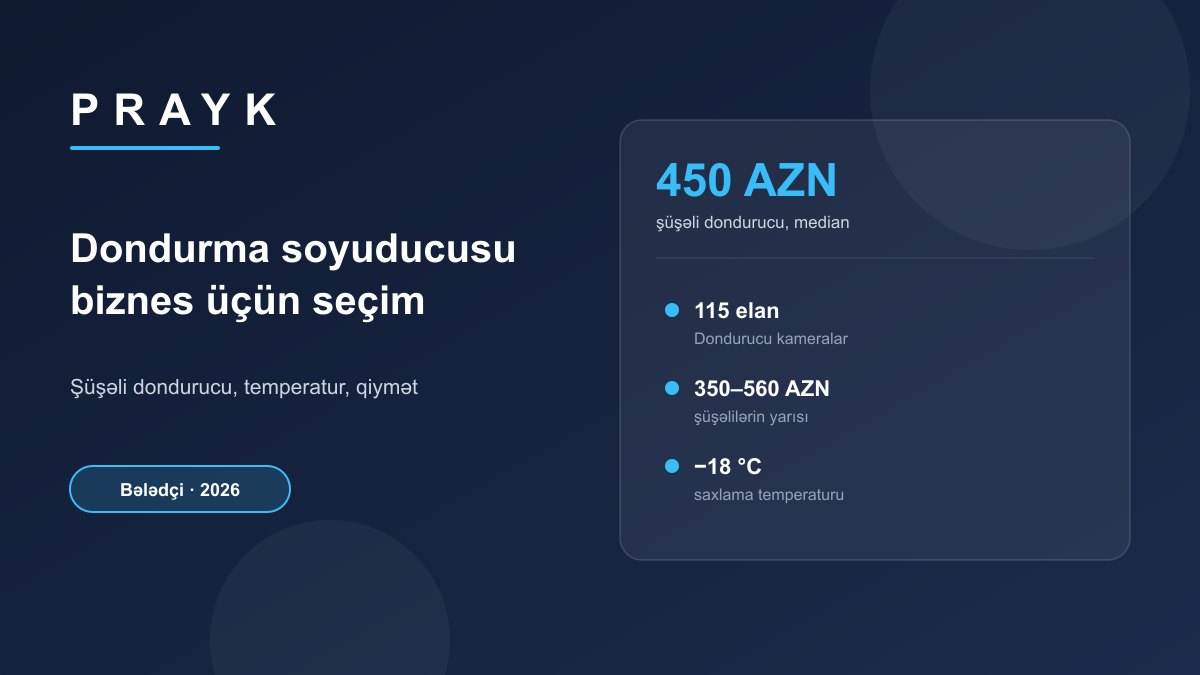
Selling ice cream requires a freezer that holds −18 °C or lower steadily. Small shops and kiosks mostly use a horizontal chest freezer with a sliding glass lid, while cafés and gelato shops use a scooping display cabinet. When buying a used unit, measure the temperature with a thermometer, inspect the lid seals and check the inner walls for rust. Prayk currently has 47 freezer listings with "şüşəli" (glass) in the title, with a median price of 450 AZN.
Short answer: as of 22 September 2026, Prayk's Freezing chambers section has 115 listings with a median price of 470 AZN (half 350–690 AZN). The 47 freezers with "şüşəli" (glass) in the title have a median of 450 AZN (half 350–560 AZN), and the 15 listings with "dondurma" (ice cream) in the title have a median of 500 AZN (half 325–675 AZN). Ice cream is stored at −18 °C or lower; a glass-lid chest freezer suits a small outlet, and a scooping cabinet suits sales by the scoop.
Which type of freezer do you need for ice cream?
The choice depends on what you sell and how: packaged ice cream (sticks, cups, cones) or scooped ice cream sold by weight. Physics matters too: cold air is heavier and stays low. So a chest that opens from the top loses little cold when the lid is lifted, while an upright freezer with a front door spills cold air every time it is opened.
| Type | Who it suits | Pros | Cons |
|---|---|---|---|
| Chest with sliding glass lids | Shop, kiosk, beach or park stand | Products visible, little cold lost when opened | Customers have to lean in; glass can fog up |
| Chest with solid lid | Storage, back stock | Good insulation, low energy use | No display function |
| Upright glass-door freezer | Packaged ice cream, tight spaces | Small footprint, products at eye level | More cold lost when the door opens, higher energy use |
| Scooping display cabinet | Café, gelato shop | Sales by weight, attractive display | More expensive, needs daily care |
In a scooping cabinet, ice cream is usually kept slightly softer, at about −11...−14 °C, so it is easy to scoop; back stock should stay in a separate freezer at −18 °C.
How much do ice cream freezers cost on Prayk?
| Segment | Listings | Median price | Middle half of listings |
|---|---|---|---|
| Freezing chambers section | 115 | 470 AZN | 350–690 AZN |
| "Şüşəli" (glass) in the title (freezing chambers and freezers) | 47 | 450 AZN | 350–560 AZN |
| "Dondurma" (ice cream) in the title (refrigerated displays, freezing chambers, freezers) | 15 | 500 AZN | 325–675 AZN |
| Household freezers section | 140 | 680 AZN | 500–1,006 AZN |
| "Ice cream freezers" subsection | 1 | — | single listing, 600 AZN |
Notably, the dedicated "Ice cream freezers" subsection holds just one listing: sellers mostly place ice cream chests in the Freezing chambers and Refrigerated display cases sections, so start your search there. Of the 15 listings with "dondurma" in the title, 11 are in the refrigerated display category. Examples from the catalogue: a glass-lid freezer made by Uğur at 430 AZN, an ice cream display with sliding glass lids at 300 AZN and a large horizontal ice cream display at 750 AZN. Of the freezing chamber listings, 69 (60%) are in Baku, 21 in Digah, 6 in Masazir and 4 in Mehdiabad. Listings in the household freezers section are almost entirely new units from Baku shops, so read the 680 AZN median as a new-unit price.
Why does −18 °C matter?
International practice for storing frozen food is −18 °C or lower. For ice cream, stability matters as much as the number: when ice cream softens and refreezes repeatedly, large ice crystals form, the texture turns grainy, the shape suffers and customers notice immediately. A useful habit is to keep a separate thermometer inside the freezer and note the temperature every morning and evening — it helps you spot a fault early and show storage conditions during an inspection. For exact food safety requirements, consult the Azerbaijan Food Safety Agency.
Climate class and summer heat
The climate class on the rating plate shows the room temperature range in which the unit works properly. For a kiosk that heats up in summer, a spot in front of a sunny window or an open terrace, choose an ST (up to 38 °C) or T (up to 43 °C) class freezer. The classes are explained in detail in our guide to drinks fridges and mini fridges.
How do you work out the size?
- Start from turnover. Count how many packs and sticks you sell between two deliveries and add a margin for the seasonal peak. An oversized freezer in a small outlet wastes electricity, while an undersized one leaves shelves empty on hot days.
- Respect the load line. Open and glass-lid chests have a maximum load mark inside; products stacked above it do not stay at the right temperature.
- Measure the space. Check the door width, floor area, clearance around the unit for airflow and an earthed socket in advance. For a seasonal stand, a model on wheels makes moving easier.
How do you check a used freezer?
- Have it switched on in advance. Ask the seller to switch the empty unit on a few hours before you arrive. On site, measure with your own thermometer: it should read −18 °C or lower.
- Look at the frost. In chest freezers the evaporator tubes run inside the walls. A working unit shows thin, even frost on the walls; frost on only part of the walls, or none at all, can mean low refrigerant.
- Inner walls and floor. Look for rust, holes and bulges. If corrosion has reached the tubes inside the wall, repair is often not worth it.
- Compressor and condenser. The sound should be even, without vibration. A thick layer of dust on the condenser (usually at the back or underneath) shows the unit has worked in harsh conditions.
- Lids. Glass lids should slide easily and be free of cracks, and the rubber seals should be intact; condensation and ice on the lids point to a weak seal.
- Rating plate and details. Read the model, production year, climate class and refrigerant type; check the drain plug, lock, wheels and thermostat (if there is a digital display, does it read correctly?).
- Ownership. A freezer carrying an ice cream brand's logo may be distributor inventory — ask the seller to confirm that the unit belongs to them.
Transport the unit upright; if it has been laid on its side, wait a few hours before switching it on so the oil can return to the compressor. If a fault appears after purchase, you can contact fridge and freezer repair technicians.
How can you cut electricity costs?
A freezer runs around the clock, so electricity is one of the main costs over its lifetime. In the EU, since March 2021, refrigerating appliances with a direct sales function, including ice cream freezers, carry an energy label (Regulation 2019/2018) — look up the model code in the EPREL registry to see its energy class. The daily rules are simple: keep the freezer away from sun and heat sources, leave a gap to the wall, cover the glass lid with a night blind and defrost the unit when the ice layer passes about half a centimetre. Electricity tariffs for non-household consumers are published by the Tariff (Price) Council.
What does Prayk offer business owners?
- Looking for a freezer before the season? Save your search and get notified as soon as a new listing appears: search agent.
- If you are an ice cream or drinks wholesaler, you can manage orders, prices and a credit ledger in the Prayk Topdan module.
- When selling your old freezer, put the type (glass-lid, chest, upright), length or capacity and climate class in the title, and add a photo of the running unit with the thermometer reading — for a buyer that is the strongest proof.
Frequently asked questions
How much does an ice cream freezer cost?
As of 22 September 2026, the 47 freezer listings on Prayk with "şüşəli" (glass) in the title have a median price of 450 AZN, with half between 350 and 560 AZN. The 15 listings with "dondurma" (ice cream) in the title have a median of 500 AZN, and the whole Freezing chambers section (115 listings) has a median of 470 AZN.
At what temperature should ice cream be stored?
Ice cream is stored at −18 °C or lower. In scooping display cabinets it is kept at about −11...−14 °C so it is easy to scoop, while back stock stays in a separate freezer at −18 °C.
Should you choose a chest or an upright freezer?
For a small shop or kiosk, a glass-lid chest freezer is usually more economical: cold air stays low, so little is lost when the lid opens. An upright glass-door model takes less floor space and shows products at eye level, but loses more cold each time it is opened.
How do you check a used ice cream freezer?
Ask the seller to switch the empty unit on a few hours before you arrive and confirm with your own thermometer that it holds −18 °C. Check for even frost on the walls, no rust inside, and intact glass lids and seals.
Can you keep ice cream in a drinks fridge?
No. Drinks fridges and mini fridges are designed for above-zero temperatures, while ice cream needs −18 °C. Ice cream needs a freezer, and drinks need a separate glass-door refrigerated display.
Why does a freezer's glass lid fog up?
Condensation and ice usually appear when the rubber seal has weakened, the lid does not close fully or the freezer stands in a humid, warm spot. Check the seals, move the unit away from sun and heat sources, and cover the lid with a night blind.
Sources and methodology
Counts and prices were taken on 22 September 2026 from Prayk's public listing catalogue (Freezing chambers, Freezers, Refrigerated display cases and Ice cream freezers sections). "Listings" is the number of active listings in the section or in the title search at that moment. The median and "middle half" (25th–75th percentile range) are calculated from the newest listings, using AZN prices only; no median is given for a subsection with a single listing. The energy label follows EU Regulation 2019/2018. Official sources: Azerbaijan Food Safety Agency, EPREL, Tariff (Price) Council.