Used air conditioner: how to choose, what to check, what it costs
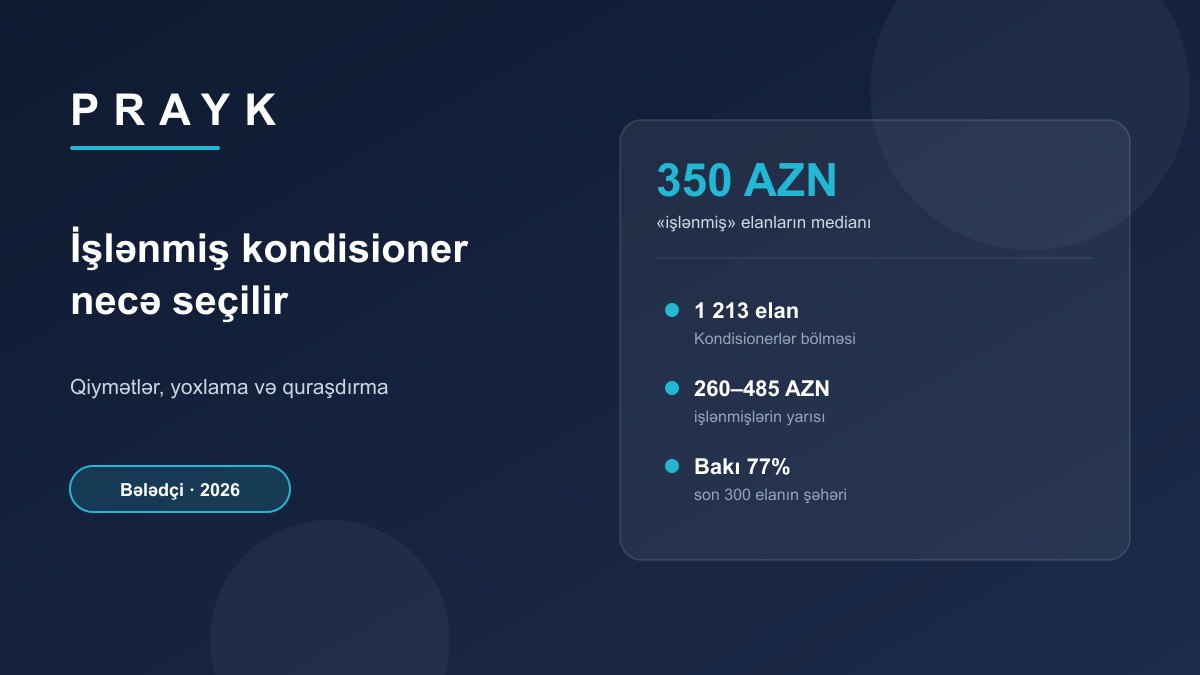
A used air conditioner is worth buying if you see it installed and running, measure the cooling with a thermometer, inspect the outdoor unit for oil stains and rust, and read the production year and refrigerant type off the rating plate. Add removal, transport, copper piping, vacuuming and installation to the price: a badly installed unit can fail in its first season. Prayk currently has 1,213 air conditioner listings, and those marked "işlənmiş" (used) in the title have a median price of 350 AZN.
Short answer: as of 22 September 2026, Prayk has 1,213 air conditioner listings; the median of the latest 300 is 500 AZN (half of them 250–857 AZN). The 55 listings with "işlənmiş" (used) in the title have a median of 350 AZN, with half between 260 and 485 AZN. For comparison, listings with 12000 BTU in the title, mostly new units, have a median of 790 AZN. Before buying, measure the cooling, inspect the outdoor unit and the refrigerant type, and get an installation quote from a technician in advance.
How much does a used air conditioner cost on Prayk?
In the air conditioner section, new units from shops and used split systems from private sellers share one list. To read prices correctly, we split the listings into segments. Figures are calculated from the newest listings in each segment, using AZN prices only.
| Segment | Listings | Median price | Middle half of listings |
|---|---|---|---|
| All air conditioners (latest 300) | 1,213 | 500 AZN | 250–857 AZN |
| "İşlənmiş" (used) in the title | 55 | 350 AZN | 260–485 AZN |
| 9000 BTU in the title | 28 | 630 AZN | 550–762 AZN |
| 12000 BTU in the title | 33 | 790 AZN | 630–1,250 AZN |
| 18000 BTU in the title | 29 | 1,140 AZN | 950–1,600 AZN |
| "Inverter" in the title | 132 | 1,324 AZN | 950–1,762 AZN |
The BTU and inverter rows are mostly new units from shops, so read them as a new-price benchmark. The "used" row mixes units of different capacity, from models for 30–35 m² to models for 85–90 m². As a rough comparison, the used median (350 AZN) is less than half of the median for new 12000 BTU offers (790 AZN), but installation eats part of that gap. Of the latest 300 listings, 232 (77%) are in Baku, followed by Digah (31), Masazir (9) and Sumgait (6).
What capacity do you need, and what is BTU?
BTU (British Thermal Unit) measures how much heat an air conditioner removes from a room per hour. One kilowatt is about 3,412 BTU/h, so 9000 BTU is roughly 2.6 kW of cooling, 12000 BTU is 3.5 kW, 18000 BTU is 5.3 kW and 24000 BTU is 7 kW. Capacity often shows in the model code too: "09", "12" or "18" in the name usually means 9000, 12000 or 18000 BTU.
Shop listings on Prayk state 20–30 m² for 9000 BTU, 30–40 m² for 12000 BTU and 50–60 m² for 18000 BTU. That is an estimate for a standard ceiling height and average insulation. If the room faces the sun, is on the top floor, has a high ceiling or opens onto the kitchen, it makes sense to go one size up. An undersized unit runs non-stop on hot days, cannot cool the room and wears out its compressor faster.
What should you check before buying?
The safest option is to see the unit at the seller's home while it is still on the wall and working. Bring a simple digital thermometer and go through these steps:
- Rating plate. On the label on the side of the indoor unit, find the model code, production year, cooling capacity and refrigerant type (R22, R410A, R32), and take a photo. Search the code online to confirm the model year.
- Cooling test. Set cooling mode to the lowest temperature and wait 10–15 minutes. A difference of about 8–12 degrees between the air leaving the indoor unit and the room air is a practical sign that the system works normally. A smaller gap can mean low refrigerant or a weak compressor.
- Heating mode. If the unit also heats, switch modes and check for warm air — important if you plan to use it in winter.
- Outdoor unit. The fan should spin freely, the coil fins should not be crushed and the casing should not be rotting. An oily stain at the pipe connections is the most typical sign of a refrigerant leak.
- Noise and vibration. The compressor should start smoothly; metallic knocking, strong vibration and frequent on-off cycling are warning signs.
- Drainage. After 15–20 minutes of cooling, water should drip from the drain hose. If water runs down the wall from under the indoor unit, the drain is blocked or the unit hangs at an angle.
- Smell. A musty smell in the first minutes means the indoor unit has not been cleaned for a long time — budget for a professional clean.
- Remote and display. Test every button and the timer, and watch whether an error code appears on the display.
If the unit has already been removed
A removed unit cannot be tested while running, so the risk is yours and the price should reflect it. Ask the seller whether the refrigerant was pumped into the outdoor unit before removal (technicians call it a "pump down"), whether the pipe ends were sealed and how long the unit has been out of use. Try to agree in writing, in the chat, on a return if it does not cool after installation.
Why does the refrigerant type matter?
Many older air conditioners run on R22. Because it depletes the ozone layer, its production is being phased out under the Montreal Protocol, and servicing such units is getting harder. Newer units use R410A, and models from recent years use R32. When choosing a used unit, R410A or R32 is the easier choice for long-term servicing. The refrigerant type is always printed on the rating plate.
Inverter or conventional air conditioner?
A conventional (on/off) unit switches the compressor off completely once the room reaches the set temperature, then restarts it at full power. An inverter adjusts the compressor speed, keeps the temperature steadier, usually uses less electricity and runs more quietly. Prayk has 132 listings with "inverter" in the title, with a median price of 1,324 AZN, and most are new units. A used inverter has a more complex control board than a conventional model, so repairs can cost more. For a unit that will run for hours every summer day, an inverter makes sense; for a room that needs cooling a few weeks a year, a sound conventional model can be enough. Electricity tariffs are published by the Tariff (Price) Council.
Removal, transport and installation: the hidden costs
The listing price is only the start. Removal at the seller's home, transport, drilling the wall, extending or replacing the copper pipes, vacuuming the line, a refrigerant top-up if needed and a bracket for the outdoor unit are all paid separately. Do not agree to skip vacuuming: air and moisture left in the line shorten the compressor's life. The sensible approach is to get an installation quote before buying and, if possible, take the technician with you to the inspection. On Prayk you can find technicians near you under air conditioner installation and repair.
How to deal with the seller and stay safe
- First ask in the Prayk chat for the model code, production year and whether the unit has been removed — the answers stay in writing.
- Do not send a deposit or the full amount before seeing the unit. Suspicious payment requests are flagged automatically in Prayk chat — read more about chat safety.
- To judge the price, check the market prices page and the market comparison on the listing page.
- If nothing suitable is listed, save your search and get notified when a new listing appears — this is how the search agent works.
- Use any faults you find during the inspection (leak traces, missing remote, musty smell) as arguments when negotiating.
If you are selling your old air conditioner
State the capacity (BTU or m²), production year, refrigerant type, whether the unit is still on the wall and whether it is an inverter, and add a photo of the rating plate. If it is still installed, film a short clip of it running — the buyer's first question is usually "does it cool?". For tips on filling in the listing, see the rules of a listing that sells fast. All offers are in the Air conditioners and split systems section.
Frequently asked questions
How much does a used air conditioner cost?
As of 22 September 2026, the 55 air conditioner listings on Prayk with "işlənmiş" (used) in the title have a median price of 350 AZN, with half of them between 260 and 485 AZN. The price depends on capacity, brand, age and whether the unit has already been removed.
How do you check a used air conditioner?
Run the installed unit in cooling mode for 10–15 minutes and use a thermometer to confirm the air coming out is about 8–12 degrees cooler than the room. On the outdoor unit, look for oil stains at the pipe connections, rust and fan damage, and make sure water flows from the drain and the compressor runs without vibration.
How many square metres does a 9000 BTU air conditioner cover?
Shop listings on Prayk state 20–30 m² for 9000 BTU, 30–40 m² for 12000 BTU and 50–60 m² for 18000 BTU. For a sunny room, a top-floor flat or a high ceiling, choosing one size up is the safer option.
Is an R22 air conditioner worth buying?
R22 depletes the ozone layer, so its production is being phased out under an international agreement and servicing R22 units is getting harder. Unless the price is much lower, a model running on R410A or R32 is the easier long-term choice.
Is it risky to buy an air conditioner that has already been removed?
Yes, because a removed unit cannot be tested while running. Ask whether the refrigerant was pumped into the outdoor unit before removal and whether the pipes were sealed, factor the risk into the price and, if possible, agree in writing on a check after installation.
Who should install a used air conditioner?
A professional technician with a vacuum pump and gauges to check refrigerant pressure should do it. Ask for the price before buying; Prayk's "Masters" section has listings from air conditioner installation and repair technicians.
Sources and methodology
Counts and prices were taken on 22 September 2026 from Prayk's public listing catalogue (Air conditioners and split systems section). "Listings" is the number of active listings in the section or in the title search at that moment. The median and "middle half" (25th–75th percentile range) are calculated from the newest listings in each segment (the latest 300 for the whole section), using AZN prices only. The BTU and inverter segments are selected by those words appearing in the title and mostly reflect new units. The BTU conversion is a physical ratio (1 kW ≈ 3,412 BTU/h). The official source for electricity tariffs is the Tariff (Price) Council; energy data for a specific model can be looked up in the EU EPREL registry.