Sheep shearing machines: types, combs and cutters, care and prices
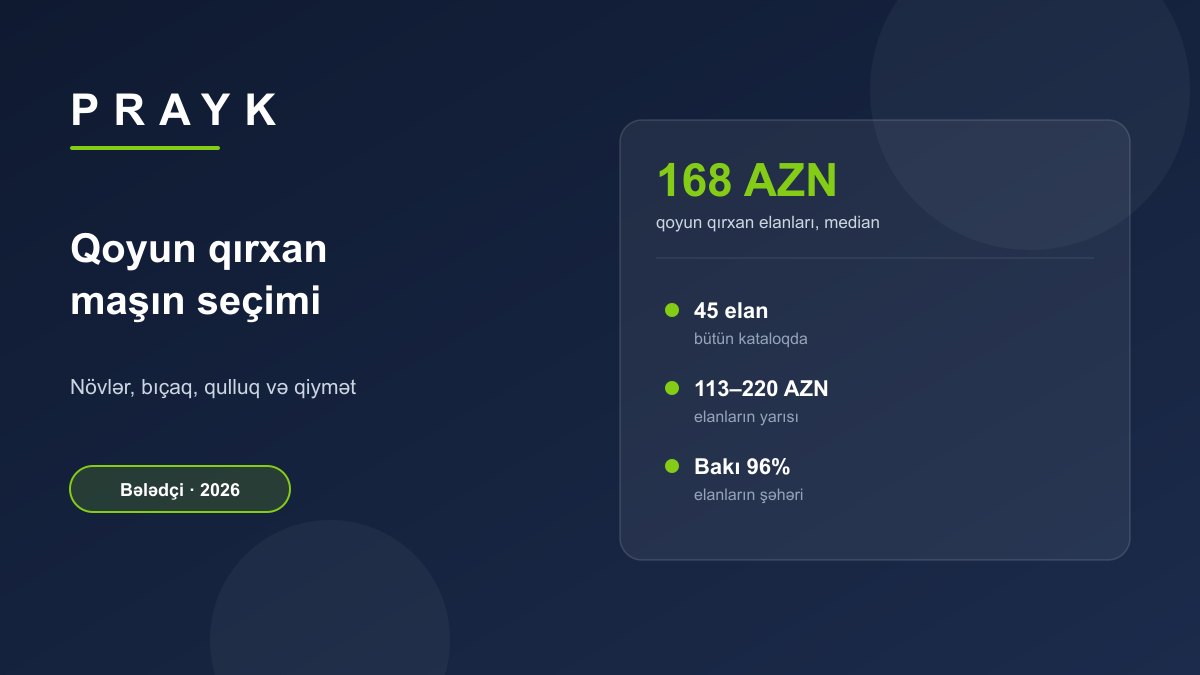
Choose sheep shears by flock size and access to electricity: for a few head, an ordinary corded or cordless handpiece is enough, while shearing dozens of sheep calls for a powerful corded machine that runs long without overheating, or a flexible-shaft model with a hanging motor. The quality of the cut depends less on the machine itself than on the blade set — the comb and the cutter. Prayk currently has 45 listings mentioning "qoyun qırxan" (sheep shears), with a median price of 168 AZN.
Short answer: as of 22 September 2026, the Prayk catalogue has 45 listings mentioning "qoyun qırxan"; the median price is 168 AZN and half of the listings sit between 113 and 220 AZN (spare blade sets included). 43 of them are in Baku, and 30 are posted not in a specialised section but in the general "Products" section.
What types of sheep shears are there?
A sheep shearing machine is an electric tool whose fast side-to-side cutter removes the fleece close to the skin in one piece. By design there are four options:
- Corded electric handpiece — the motor sits inside the body and runs on 220 V mains. The most common type, with steady power. The body heats up during long sessions, so large flocks need breaks.
- Cordless (battery) machine — no cable, so you can work on pasture, on summer grazing grounds and in barns without power. How many head you shear per charge depends on battery capacity and fleece density, so a spare battery helps.
- Flexible-shaft (hanging motor) machine — the motor hangs from a stand or the ceiling and drives the handpiece through a flexible shaft. The handpiece stays light and cool, so these are built for large flocks and season-long shearing. Prayk has listings for such "industrial" models too.
- Manual blade shears — a hand tool with no power. Useful for a few animals, places without electricity or as a backup if the machine fails, but slow and skill-dependent.
Two tools are easy to confuse with sheep shears: clippers for cattle and horses use finer blades, while grooming clippers for dogs and cats jam and overheat in dense sheep wool. Before buying, look for "for sheep" or "for wool" in the description.
Which machine suits your flock?
| Flock and conditions | Suitable type | What to check |
|---|---|---|
| A few head in the yard, one or two shearings a year | Simple corded or cordless handpiece | Availability of spare blade sets |
| Dozens of head, barn with steady power | Powerful corded handpiece | Body ventilation, heat tolerance, cable length |
| Pasture or summer grazing, no electricity | Cordless, or corded with a generator | Battery capacity, spare battery |
| Large flock, professional seasonal shearing | Flexible-shaft machine | Handpiece weight, several blade sets, service |
| Goats or cattle as well as sheep | Model with interchangeable blades, or a separate clipper | Which blade is for which animal |
Blades: why do the comb and cutter matter so much?
A blade set has two parts. The comb (the lower, wide toothed blade) enters the fleece and separates it into strands. The cutter (the upper blade with fewer teeth) moves rapidly across the comb and slices the wool. Sheep combs usually have 13 teeth; tooth shape differs for dense, dirty fleece and for fine wool.
- Tension screw presses the cutter onto the comb. Too tight and the blades and motor overheat and wear quickly; too loose and the wool is not cut and jams between the teeth. Find the lowest tension that still cuts cleanly.
- Lubrication — during work, regularly drip the oil recommended by the manufacturer onto the point where comb and cutter meet. A dry blade set heats up and dulls within minutes.
- Sharpening — combs and cutters are ground on a special sharpening disc; getting a flat surface on an ordinary whetstone is hard. During the season it helps to rotate two or three sets and send dull ones for grinding.
- Spare blades — before buying, make sure blade sets for that model are sold separately. Spare sets appear on Prayk as listings too: for example, one listing offers a cutting head for sheep shears at 38.99 AZN.
How much do sheep shears cost on Prayk?
The figures were calculated from the Prayk catalogue on 22 September 2026. There is no dedicated section for sheep shears, so the key indicator is a keyword search.
| Selection | Listings | Price |
|---|---|---|
| Whole catalogue, "qoyun qırxan" | 45 | median 168 AZN; half 113–220 AZN (blade sets included) |
| Whole catalogue, "yunqırxan" | 7 | 39–180 AZN (small sample) |
| "Agricultural equipment" section | 166 | median 345 AZN; half 106–750 AZN (all equipment types) |
| "Farm animals", word "qoyun" (sheep) | 108 | median 385 AZN; half 214–675 AZN (sometimes several head per listing) |
What these numbers tell you:
- Search by keyword, not by section. 30 of the 45 listings are in the general "Products" section and only a few in Pet supplies; the Agricultural equipment section mostly holds other gear such as milk cans, beehives and feed crushers. Type "qoyun qırxan", "yunqırxan" and "qırxım maşını" into the search box one at a time.
- Almost all listings are in Baku. 43 of the 45 listings are in Baku, whereas only 28 of the 108 sheep listings are; the rest are in Digah, Quba, Shabran, Sumgayit and elsewhere. If you live in the regions, ask the seller up front about delivery, warranty and where blades can be sharpened.
- A machine costs less than a sheep. The median shears listing (168 AZN) is less than half the median sheep listing (385 AZN). Add up what you pay for shearing each season — even with a small flock, your own machine can pay for itself within a few seasons.
If the model you need is not listed, post a "Looking for" listing so sellers can find you, or save your search.
How to prepare for shearing and look after the machine?
- Wool must be dry. Wet fleece dulls blades fast, loads the motor and spoils in storage. Postpone shearing on a rainy day.
- Prepare the floor. A clean, dry floor or tarpaulin keeps the fleece clean; keep the cable away from the animal's feet.
- Use even strokes. Move the handpiece in long, calm strokes along the skin and keep the skin taut with your other hand — most nicks happen in skin folds.
- Take breaks. When the body gets too hot to hold comfortably, stop, oil the blades and brush out wool residue.
- Check the carbon brushes. In brushed motors they wear out; when the machine loses power and sparks more, replace them.
- Electrical safety. Barns are damp — use an earthed socket and a residual-current device (RCD), and never work with a damaged cable.
- Hygiene. Clean and disinfect blades between different flocks so skin diseases do not spread from one flock to another. For animal health questions, consult a veterinarian.
In Azerbaijan sheep are usually shorn in late spring to early summer, and some farms carry out a second shearing in autumn. Check the machine a week or two before the season: spare blades sharpened, oil and brushes at hand.
What to check when buying a used machine?
Switch the machine on in front of the seller and let it run for a few minutes: the sound should be even and the body should not overheat quickly. Check that no comb teeth are broken, that the tension screw turns freely and that the cable is intact. For a cordless model, ask how old the battery is and how long it holds a charge. Make sure blades for the model are still on sale — without them a cheap machine is useless.
If you are selling your machine
List the brand and model, power (W), type (corded, cordless, flexible-shaft), how many blade sets are included and how many seasons it has worked. A short video of it running answers the buyer's most common question. For price guidance see the market prices page, and post the listing in Agricultural equipment or Pet supplies. For selling sheep there is the Farm animals section. To sell faster, follow these rules.
Frequently asked questions
How much do sheep shears cost?
As of 22 September 2026, the Prayk catalogue has 45 listings mentioning "qoyun qırxan"; the median price is 168 AZN and half of the listings cost 113–220 AZN. The list includes spare blade sets sold separately, so check whether a cheap listing is a machine or just a blade.
Should I buy corded or cordless sheep shears?
If your barn has steady power and you shear many animals, a corded machine keeps the same power for long sessions. On pasture, summer grazing grounds and anywhere without electricity, a cordless machine is convenient, but for many head you need a spare battery. For large flocks, professionals prefer flexible-shaft machines.
Can sheep shears be used on goats and cows?
Some models come with interchangeable blade sets for different animals, but a sheep comb does not always suit goat or cattle hair. Cows and horses are usually clipped with finer-toothed clippers. Check the model description to see which blade is meant for which animal.
Why does the machine overheat and tear the wool?
The most common causes are a dull blade, lack of oil, an overtightened tension screw and wet wool. Oil the blade set, reduce tension to the minimum that still cuts cleanly, swap the dull set for a sharpened one and let the machine cool down.
When should the blades be sharpened?
If the machine does not cut the fleece in one pass, wool jams between the teeth, the animal becomes restless or the body heats faster than usual, the blades are dull. The comb and cutter should be ground together on a special sharpening disc; during the season it is convenient to rotate two or three sets.
Sources and methodology
Listing counts and prices were taken from Prayk's public catalogue API on 22 September 2026: catalogue-wide searches for "qoyun qırxan" (45 listings) and "yunqırxan" (7 listings), the "Agricultural equipment" section (166 listings) and listings with the word "qoyun" in "Farm animals" (108). The median and the middle half of listings were calculated from AZN prices only; no median is given for groups under 15 listings. A listing price is the seller's asking price. Technical advice is general — for a specific model follow the manufacturer's manual. For official information on animal health and veterinary matters see the Food Safety Agency of the Republic of Azerbaijan, and for state support to agriculture the Ministry of Agriculture.