Choosing a TV: size and distance, LED vs QLED vs OLED, and prices
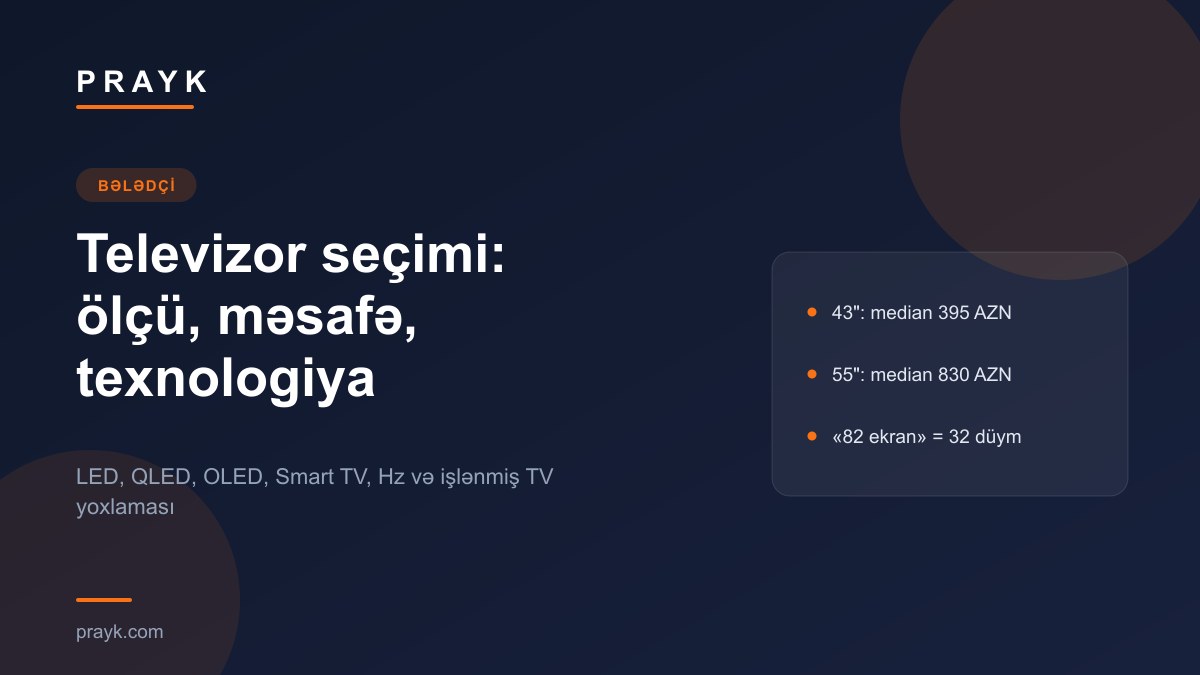
Start choosing a TV with size: the screen diagonal should match the distance from your sofa to the wall, while the panel type (LED, QLED, OLED) and Smart TV features set the budget. As of 27 September 2026, Prayk's Televisions section has 2,284 listings; among the 300 newest, the median price of a 43-inch TV is 395 AZN, a 55-inch 830 AZN and a 58–65-inch 1,119 AZN.
Short answer: for a 4K TV the viewing distance should be about 1–1.5 times the diagonal: 55–65 inches suits 2 metres, 43–50 inches suits 1.5 metres. Median prices on Prayk on 27 September 2026: 32 inches and under — 180 AZN, 40–43 inches — 395 AZN, 49–50 inches — 676 AZN, 55 inches — 830 AZN, 58–65 inches — 1,119 AZN. Listings often give the size in centimetres: "82 ekran" is about 32 inches, "109 ekran" 43 and "140 ekran" 55 inches.
What size TV is right for your room?
The commonly accepted rule: a 4K (Ultra HD) TV has smaller pixels, so you can sit closer — about 1–1.5 times the diagonal; for Full HD and HD, 1.5–2.5 times. The table below shows distances calculated with this rule alongside median prices of Prayk listings. The median is the middle price when listings are sorted: half are cheaper, half dearer.
| Diagonal | In centimetres ("… ekran") | Recommended distance | Listings (of 300) | Median, AZN | Middle half, AZN |
|---|---|---|---|---|---|
| 32 inches and under | ≈81–82 | 1.2–2.0 m (HD/Full HD) | 60 | 180 | 84–267 |
| 40–43 inches | ≈102–109 | 1.1–1.6 m (4K) | 59 | 395 | 270–599 |
| 49–50 inches | ≈124–127 | 1.3–1.9 m | 39 | 676 | 532–824 |
| 55 inches | ≈139–140 | 1.4–2.1 m | 35 | 830 | 744–1,255 |
| 58–65 inches | ≈147–165 | 1.5–2.5 m | 19 | 1,119 | 825–1,425 |
| 70 inches and over | ≈178 and over | 1.8 m and more | 14 | — | — |
Treat the table as a guide: if the distance allows, few people regret going one size up. There are few listings for 70 inches and over (14), so we do not give a median. In 73 of the 300 newest listings no size is given at all — ask the seller for the model code (in codes such as Samsung UE55… or LG 43… the digits give the diagonal).
"82 ekran", "109 ekran": how do listings state the size?
In Azerbaijan TV size is often quoted in centimetres rather than inches: "82 ekran" means an 82 cm diagonal, i.e. about 32 inches. In 106 of the 300 newest listings the size is given in centimetres or as "… ekran". To convert, divide centimetres by 2.54: 102 cm ≈ 40 inches, 109 cm ≈ 43, 127 cm = 50, 140 cm ≈ 55, 165 cm ≈ 65 inches. Do not mistake an "82 ekran" listing for an 82-inch TV: such listings sell for 70–190 AZN, while a real 82-inch screen costs thousands of manats.
LED, QLED, OLED and Mini-LED: what is the difference?
- LED (LCD) — the most common and affordable type: a liquid-crystal panel backlit by LEDs. LED or LCD is mentioned in 142 of the 300 newest listings.
- QLED — an LCD TV with a quantum-dot layer: richer colours and higher brightness. Mentioned in 15 listings.
- Mini-LED, QNED, NanoCell — improved versions of LCD; in Mini-LED many small light sources allow deeper blacks. Found in 11 listings.
- OLED — each pixel emits its own light, so black is truly black and viewing angles are wide. Showing the same static image (a logo, a news ticker) for long periods carries a risk of burn-in. Only 5 of the 300 newest listings are OLED.
Smart TV. More than half the listings (159) mention Smart TV, Android TV, Google TV, webOS or Tizen. Smart features let you open apps (YouTube, streaming services) directly on the TV; bear in mind that apps may no longer be updated on older models — an inexpensive TV box can solve that.
Hz (refresh rate). Most TVs have 50/60 Hz panels; for sport and games consoles, 100/120 Hz gives smoother motion. Marketing figures such as "Motion Rate" often describe processing technology rather than the panel's real refresh rate — look for the "native" rate in the specifications. Only 4 of the 300 newest listings state 120 Hz, while 4K (Ultra HD) is mentioned in 102.
New or used: how big is the price gap?
Of the section's 2,284 listings, 1,398 come from shops and 886 from private sellers. Shop listings are mostly new TVs, while private sellers' are usually used. Sizes with at least 15 listings in each group:
| Diagonal | Shops: listings / median, AZN | Private sellers: listings / median, AZN |
|---|---|---|
| 32 inches and under | 26 / 249 | 34 / 95 |
| 40–43 inches | 21 / 399 | 38 / 330 |
| 49–50 inches | 20 / 689 | 19 / 630 |
The gap is large for small screens: the median 32-inch TV from a private seller is 95 AZN versus 249 AZN from a shop. At 43–50 inches the gap is only 60–70 AZN, so a used TV without a warranty saves little compared with a new one. This comparison assumes "shop = new" and is approximate.
What should you check when buying a used TV?
- Find the model code and year. The label on the back usually shows the model code and often the production date; use the code to check the panel type and refresh rate on the official website.
- Test the screen on solid colours. On white, black, red, green and blue there should be no dead pixels, lines, dark patches or light bleed at the edges. Dark zones or a bluish tint can mean the backlight LEDs are wearing out.
- Run it for at least 15–20 minutes. Switching off or restarting on its own once warm is a sign of a power-supply fault.
- Test every input: HDMI, USB, aerial input, Wi-Fi and Bluetooth; sound from the speakers should be clean.
- Check the remote and Smart features: apps should open and the system should update; the seller should sign out of their accounts and reset the TV to factory settings.
- Ask whether the stand or wall bracket is included — buying one separately is an extra cost.
- Plan transport. Carry a large screen upright and do not press on the panel; the original box is a bonus.
Listings are in the Televisions section, and brackets and stands have their own section. You can check the seller's number on the "Check a phone number" page and compare a listing's price with the market using the "Check a listing" report. If the right model is not available yet, save your search — you will be notified when a new listing appears. We described similar checks for other appliances in our used fridge guide.
Frequently asked questions
What size TV do I need for a 2-metre viewing distance?
For a 4K TV the distance should be about 1–1.5 times the diagonal, so 55–65 inches suits 2 metres. For Full HD, 43–50 inches is more comfortable at the same distance.
How many inches is "82 ekran"?
"82 ekran" means an 82 cm diagonal, i.e. about 32 inches. To convert centimetres to inches, divide by 2.54: 109 cm ≈ 43 inches, 140 cm ≈ 55 inches.
How much does a 55-inch TV cost?
As of 27 September 2026, 35 of the 300 newest TV listings on Prayk are 55-inch: the median price is 830 AZN, with the middle half at 744–1,255 AZN. The price depends heavily on panel type (LED, QLED, OLED) and brand.
OLED or QLED?
OLED has better blacks and contrast and wins for films in a dark room, but static images carry a burn-in risk. QLED is brighter, better suited to a bright room and long hours on one channel, and usually cheaper.
Is a used TV worth buying?
For small screens, yes: the median 32-inch TV from a private seller is 95 AZN versus 249 AZN from a shop. At 43–50 inches the gap is only 60–70 AZN, so a new TV with a warranty often makes more sense. Before buying, test the screen on solid colours and let the TV run for 15–20 minutes.
Sources and methodology
Listing counts and prices come from Prayk's public catalogue API on 27 September 2026: the TV and Video → Televisions section (2,284 listings; 1,398 from shops, 886 from private sellers) and its 300 newest listings. The diagonal was read from the listing title and description: inches, centimetres ("… ekran", "sm") and model code; centimetres were converted to inches by dividing by 2.54. Medians and 25th–75th percentiles use AZN prices only; we do not publish a median for bands with fewer than 15 listings. Mentions of technologies and features (LED, QLED, OLED, Smart TV, 4K, 120 Hz) were counted by keywords in titles and descriptions. The distance table follows a commonly accepted guideline (1–1.5 times the diagonal for 4K, 1.5–2.5 times for Full HD); check the specifications of a particular model on the manufacturer's official website.