Swapping cars by barter: how to work out the top-up, risks, papers
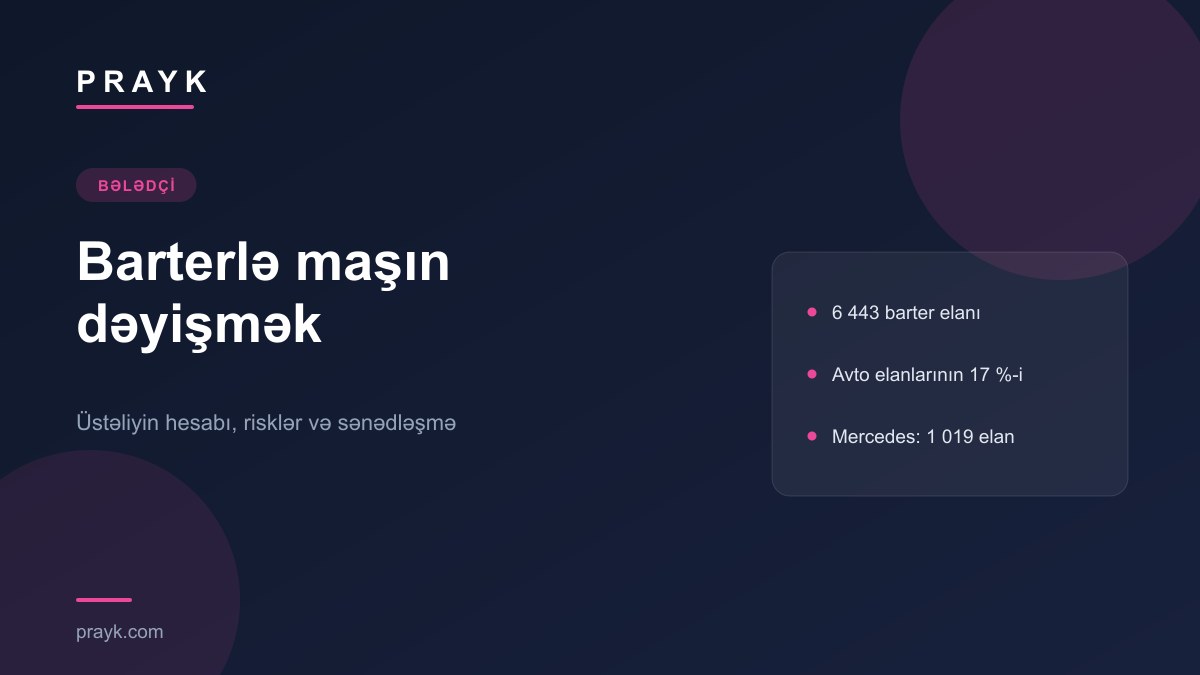
Swapping cars by barter means exchanging one car for another instead of money, with the price difference paid as a cash “top-up”. On 27 September 2026, sellers of 6,443 car listings on Prayk had marked that they accept barter — about 17% of the 38,299 listings in the “Cars” section. To make a swap fair, measure the market value of both cars separately, calculate the difference from those values and formalise the transfer of both cars at a notary.
Short answer: the top-up in a barter is the difference between the two cars’ market values, not their asking prices. Value both cars the same way — for example with “What’s my car worth?” — and account separately for differences in condition (accident damage, mileage, repairs needed). On Prayk, cars open to barter are listed at practically the same price as other listings of the same model and year: the median ratio across 32 comparisons is 0.98. Formalise the swap at a notary and exchange money, documents and keys at the same time.
How many barter listings are on Prayk?
When a seller ticks the “Barter” field in a car listing, it appears on the Barter listings page. The page selects listings by that field alone; since the “Barter” field currently exists only in the car listing form, every listing on the page is a car. You can filter by make (for example, Mercedes barter listings) and sort by newest or by price. Figures for 27 September 2026:
| Indicator | Value |
|---|---|
| Listings accepting barter (all) | 6,443 |
| Mercedes | 1,019 |
| Hyundai | 734 |
| Lada (VAZ) | 588 |
| Total listings in the “Cars” section | 38,299 |
| Share of barter listings | ≈17% |
In a sample of the 800 most recent car listings, 137 (17%) accepted barter; 86 of them were posted in Baku, 13 in Sumgayit and the rest in the regions. Mercedes, Lada (VAZ) and Hyundai had the most barter listings in this sample too.
Are cars open to barter priced higher or lower?
In the same 800-listing sample, cars open to barter had a median price of 17,500 AZN (middle half 8,000–30,900 AZN), versus 13,500 AZN for the rest (8,000–21,800 AZN). But the gap mostly reflects different cars: the median model year is 2012 for barter listings and 2010 for the others. For a fair comparison we matched each barter listing against at least 3 non-barter listings of the same make and model with a model year of ±1:
| Comparison | Listings | Median ratio | Middle half of listings |
|---|---|---|---|
| Barter listing ÷ median of equivalents | 32 | 0.98 | 0.89–1.09 |
A ratio of 1.00 means the same price. So cars open to barter are neither “inflated” nor cheaper than their equivalents — by the median, just 2% lower. A barter listing does not get you a discount; its advantage is combining selling and buying into a single deal.
How do you calculate the top-up?
- Value both cars the same way. Enter each car’s make, model, year, mileage, engine and condition into “What’s my car worth?”. The tool gives a “quick sale”, “market” and “maximum” range based on similar listings. For example, on 27 September 2026 a 2018 Hyundai Elantra 2.0 L with 120,000 km had a market price of 22,500 AZN and a range of 21,500–24,000 AZN.
- Work out the difference from market prices. If your car is valued at 22,500 AZN and the other party’s at 30,000 AZN, the top-up is about 7,500 AZN. Don’t just subtract asking prices: sellers build in different bargaining margins.
- Add the difference in condition. Ask a mechanic about the cost of accident damage, repainting and repairs due soon (tyres, brakes, engine) and include it. We have a separate guide on how damage affects price.
- Consider liquidity. If you are swapping a popular, fast-selling model for a car that is harder to sell, use that in negotiation.
- Put the agreement in writing. State each car’s agreed value, the top-up amount and who pays it in the contract.
What are the risks of a barter deal?
- Hidden defects — on both sides. In a barter each party is both buyer and seller. Have the other car checked at an independent garage and measure the paint thickness.
- Legal issues. Check whether the car is under arrest, pledged or on credit, whether it has fines and whether its documents are in order — we covered which records you can check on mygov in our guide to checking a car before buying.
- Inflated valuation. The other party may overvalue their car and ask for a top-up. An independent valuation and a “Check a listing” report from the listing page (market comparison, price history) reduce this risk.
- A “swap” by power of attorney. Handing over a car by power of attorney does not change ownership: the car officially stays with the previous owner. Formalise the swap with a full transfer of ownership.
- Payment order. Don’t transfer the top-up before seeing the car or before the contract is signed. In Prayk’s chat, an automatic warning appears under messages asking for payment or containing a card number — pay attention to it.
How is a barter deal formalised?
In a barter, ownership of both cars changes hands, so both transfers must be certified by a notary. According to the ASAN xidmət service “Certification of a contract on the alienation of a vehicle”:
- Documents: for each car, the state registration certificate confirming ownership and a technical inspection document; if the owner is married, the marriage certificate and the spouse’s notarised consent.
- Parties: both sides in person or through a representative with a notarised power of attorney.
- Fee: per contract, a 70 AZN state fee and a 10.50 AZN service fee (35 + 5.25 AZN between family members).
Check with the notary in advance whether the swap is done with one contract or a separate contract for each car, and what the total fee will be. The top-up amount and payment terms should be written into the contract. Both cars are then registered to their new owners with the State Road Police; you can estimate the fee in the registration fee calculator. This is general information — confirm your situation with a notary or at ASAN xidmət.
How do you post and find a barter listing?
- When posting, tick the “Barter” field in the car listing form — the listing will automatically appear on the Barter listings page. In the description, say which cars you would swap for and whether you would pay a top-up.
- When searching, filter the barter page by make or search the Cars section. If there is no suitable car yet, save your search so you hear about new listings.
- Compare with selling: sometimes it pays more to sell your car and buy another for cash — see our guide to selling a car quickly at a fair price.
Frequently asked questions
What is barter?
Barter is exchanging goods for goods instead of money. In the car market it usually means swapping one car for another and paying the price difference — the top-up — in cash.
How many car barter listings are on Prayk?
On 27 September 2026, 6,443 car listings accepted barter — about 17% of the listings in the “Cars” section. Most were Mercedes (1,019), Hyundai (734) and Lada (VAZ) (588).
How should the top-up be calculated?
Measure the market value of both cars the same way — for example with “What’s my car worth?” — find the difference and add adjustments for condition (accident damage, repairs needed, mileage). Don’t subtract asking prices directly.
Are barter listings more expensive?
No. When 32 cars open to barter were compared with other listings of the same model and year ±1, the median ratio was 0.98 — practically the same price. The gap between the overall medians (17,500 vs 13,500 AZN) comes from barter listings being slightly newer cars on average.
Does a barter deal have to go through a notary?
Because ownership of both cars changes, the transfer is formalised with a notarised contract; according to ASAN xidmət, one contract costs a 70 AZN state fee plus a 10.50 AZN service fee. Confirm the form of contract and the total with the notary.
Sources and methodology
The number of barter listings was counted through Prayk’s public catalogue API on 27 September 2026 using listings with the “Barter” field ticked (in total and by make); the total for the “Cars” section (38,299) was taken the same day. The barter page’s selection rule was confirmed from the Prayk site code: the page selects by this field only. The price comparison used the 800 most recent listings in the “Cars” section (in AZN, above 1,000 AZN): each barter listing was compared with the median price of at least 3 non-barter listings of the same make and model with a model year of ±1; a median is given only with 15 or more comparisons. The valuation example was run the same day through the public API of “What’s my car worth?”. All figures are asking (offer) prices. Information on formalities is general; source: ASAN xidmət — certification of a vehicle alienation contract.