Original vs aftermarket car parts: differences, checks and choice
An original (OEM) spare part is the component the carmaker fits on the assembly line or has made to its order; an aftermarket part is a same-size replacement from another manufacturer. You don't need original parts everywhere: for consumables such as filters, bulbs and wiper blades a good aftermarket part does the job, but for brakes, steering, suspension and the timing drive you should choose original parts or products from brands that supply the factories. A part's real origin is shown by the VIN and the part number, not by the word "original" in a listing title.
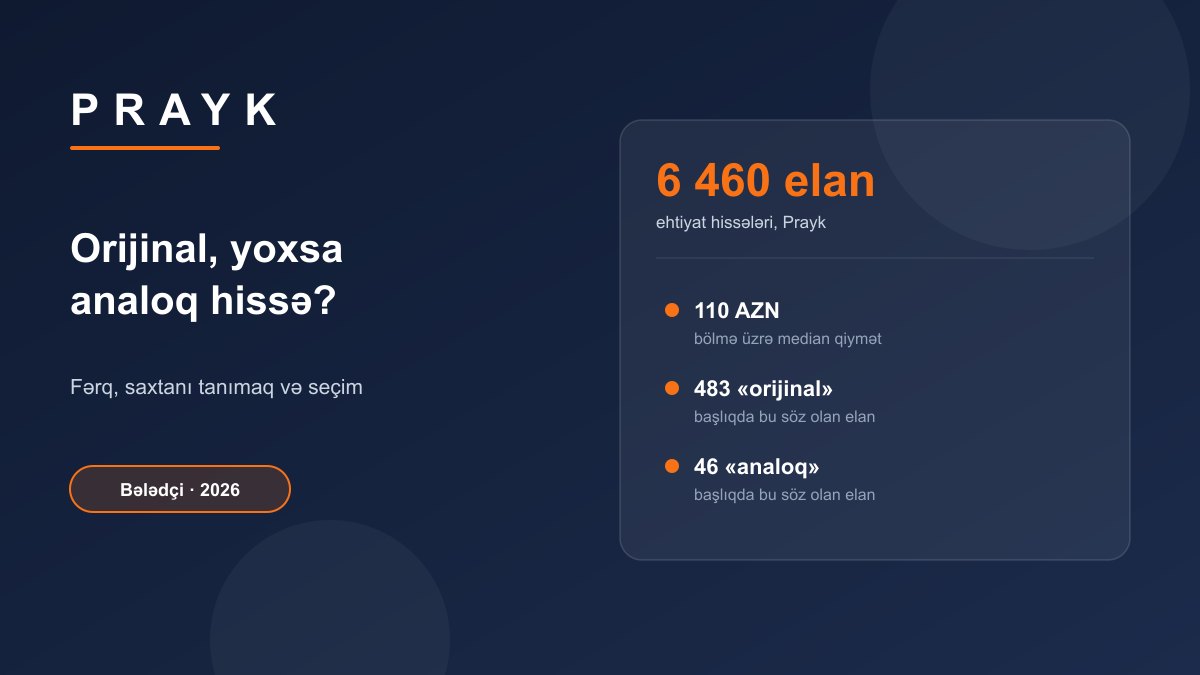
Short answer: as of 22 September 2026, Prayk's Spare parts section has 6,460 listings; the median price of the latest 299 is 110 AZN (half fall between 55 and 220 AZN). The word "original" (orijinal) appears in 483 listing titles and "aftermarket/analogue" (analoq) in only 46 — most sellers call their part original, and checking that against the part number is up to the buyer.
Original, OE, aftermarket and counterfeit: what do the terms mean?
Four terms get mixed up all the time. Telling them apart also helps when you negotiate:
- Original (OEM — Original Equipment Manufacturer) — a part sold in a box with the car brand's logo. It is identical to the one fitted at the factory and carries the brand's own part number.
- OE quality (the factory supplier's brand) — the same part sold by the brand's supplier (for example Bosch, Denso, Aisin, Valeo, TRW) in its own packaging. The design is often identical; the difference is the box and the price.
- Aftermarket — a compatible part from a third-party maker. Quality varies sharply by brand: some match factory level, others merely fit the dimensions.
- Counterfeit (replica) — an aftermarket part packaged as an original. This is the most dangerous option: the buyer pays close to the original price and nobody knows the quality.
In short: aftermarket is not bad in itself. The problem is a part of unknown origin being sold as original.
The spare-parts market on Prayk in numbers
The figures below were measured from the Prayk catalogue on 22 September 2026. Price indicators are calculated from the most recent listings in each selection, using AZN prices only.
| Selection | Listings | Median price | Middle half of listings |
|---|---|---|---|
| All spare parts | 6,460 | 110 AZN | 55–220 AZN |
| "Original" in the title | 483 | 100 AZN | 50–250 AZN |
| "Aftermarket" in the title | 46 | 53 AZN | 36–150 AZN |
| Brake system | 135 | 30 AZN | 30–45 AZN |
| Steering system | 110 | 100 AZN | 35–200 AZN |
| Car filters | 38 | 25 AZN | 10–75 AZN |
Two conclusions follow. First, "original" appears in titles roughly ten times as often as "aftermarket". That does not mean aftermarket parts are rare; it means sellers are reluctant to write the word. Second, the medians of the "original" and "aftermarket" groups cannot be compared directly: the first is dominated by headlights and tail lights (119 of the latest 300 listings are lighting), while the second has more bulbs and small parts. The brake and filter sections also mix very different goods — from bicycle rotors to truck parts — so their medians describe the section overall, not the price of a specific part. Most listings come from Baku: 234 of the latest 300 across all spare parts and 123 of 135 in the brake system section.
How do you match a part exactly to your car?
- Get the VIN. The VIN is the car's 17-character identification number; it is printed on the registration certificate, in the lower corner of the windscreen and on the sticker in the driver's door pillar. The same model in the same year comes with different engines, gearboxes and trim levels — the VIN pins all of that down.
- Find the part number. Note the number stamped on the old part or printed on its box. Once you know the original number, it is easy to find the "replaces this number" (cross-reference) entry in aftermarket makers' catalogues.
- Mind the market version. The same model built for the US, Korea, Europe or the Middle East may have different lights, sensors and some suspension parts. If the car was imported, be sure to tell the seller.
- Keep the old part. Before fitting the new one, put both side by side and compare the mounting holes, connector shape and dimensions.
How can you spot a counterfeit part?
- Box and label: blurry print, a different logo font or colour, or a missing security hologram or QR code are warning signs.
- Markings on the part itself: original and OE parts usually carry the maker's mark and number on the body (cast, stamped or laser-etched). A sticker on the box alone is not enough.
- Weight and finish: counterfeit brake pads have a thin friction layer and a light backing plate; cast parts show flash and uneven paint.
- Price: if an offer for the same part number is sharply cheaper than other listings, ask why.
- The seller's answer: an honest seller says plainly whether the part is original, OE or aftermarket, and states the country of origin and return terms.
Where does original matter, and where is aftermarket enough?
Decide not by "original or aftermarket" but by "what happens if this part fails". Where a failure leads straight to a crash or engine damage, don't economise.
| Part group | Risk | Recommendation | Buy used? |
|---|---|---|---|
| Brakes: pads, discs, drums, hoses, calipers | High | Original or an OE supplier brand | Not pads or discs |
| Steering: rack, tie-rod ends, rods, power-steering pump | High | Original or OE; have the wheel alignment checked after fitting | Only after a mechanic's check |
| Suspension: ball joints, shock absorbers, control-arm bushes | Medium–high | OE or a well-known aftermarket brand | Not recommended |
| Engine: timing belt/chain, water pump, sensors | High | Original or OE kit | No |
| Airbags, seat belts | Critical | Original and new only | No |
| Filters, bulbs, wiper blades | Low | A good aftermarket part is enough | Pointless |
| Body and lights: bumper, wing, mirror, headlight, tail light | Low–medium | Aftermarket or used original | Yes, if crack-free with intact mounts |
After replacing brake or steering parts, drive gently for the first few days. Any unusual noise, vibration or the steering pulling to one side is a reason to see a mechanic straight away — it is the quickest sign that an aftermarket part does not fit.
When does a used part from a breaker make sense?
An original part taken from a dismantled car sometimes fits better than a new aftermarket one — especially doors, bumpers, headlights, mirrors and interior trim. Before buying, check for cracks, broken mounts and corrosion; if you are buying an electronic unit, sensor or headlight, ask for a video of it working or test it on the spot; agree the return terms in writing in the chat. Don't buy friction and wear parts (pads, discs, ball joints, belts) used — nobody knows how much life they have left.
What should you look for when searching for parts on Prayk?
- Where possible, type the part number into search; to browse by section, start with Spare parts, Brake system, Steering system and Car filters.
- Don't know what the part is called? Take a photo and use search by photo.
- Ask the seller for photos of the box and of the number on the part itself; don't send a prepayment to a seller who demands one.
- If you are selling, put the make, model, year, part number and "original / OE / aftermarket" in the title — it answers the buyer's questions in advance. More: rules for a listing that sells fast.
- On how parts costs affect insurance: why comprehensive cover is getting more expensive.
Frequently asked questions
Can an aftermarket part damage my car?
An aftermarket part from a well-known maker, correctly selected and fitted, usually causes no problems. The risk lies in parts of unknown origin and counterfeits: in brakes, steering, suspension and the timing drive such a part can lead to a crash or engine damage.
How do I check that a part labelled "original" really is original?
Ask the seller for photos of the part number on the part and of the box, and have a specialist seller or a garage confirm the number matches your VIN. The label on the box should match the marking on the part, and the price should not be sharply below offers with the same number.
Where is the VIN written?
The VIN is a 17-character identification number. It appears on the registration certificate, in the lower corner of the windscreen and on the sticker in the driver's door pillar. Giving this number when ordering a part greatly reduces the chance of getting the wrong one.
Can I replace brake pads with aftermarket ones?
Yes, but only with new pads from a maker that supplies carmakers or is known for braking systems. Unknown-brand pads and used pads are not recommended. After replacement, avoid hard braking for the first hundred kilometres and see a mechanic if you hear noise or feel vibration.
How much do spare parts cost on Prayk on average?
As of 22 September 2026, the Spare parts section has 6,460 listings; the median price of the latest 299 is 110 AZN, with half between 55 and 220 AZN. This covers all kinds of parts; for a specific part, search by its part number and compare offers for the same item.
Is it safe to buy used parts?
For body panels, headlights, mirrors and interior parts, a used original can be a good-value choice, provided there are no cracks or broken mounts. Buying used brake pads and discs, ball joints, timing belts or airbags is not recommended.
Sources and methodology
The data comes from Prayk's public catalogue API on 22 September 2026. The Spare parts count includes all subsections. The "original" and "aftermarket" counts are searches for the words orijinal and analoq in listing titles within that section — they are the seller's claim, not verified origin. Medians and ranges (p25–p75) are calculated from the most recent listings in each selection (300 for all spare parts and for "original"; all listings for the other sections), using AZN prices only; obviously wrong prices are not published as minimums or maximums. The brake, steering and filter sections mix different goods (including bicycle and truck parts), so their medians should not be read as the price of a specific part.