How to haggle on second-hand deals: what discount to ask for
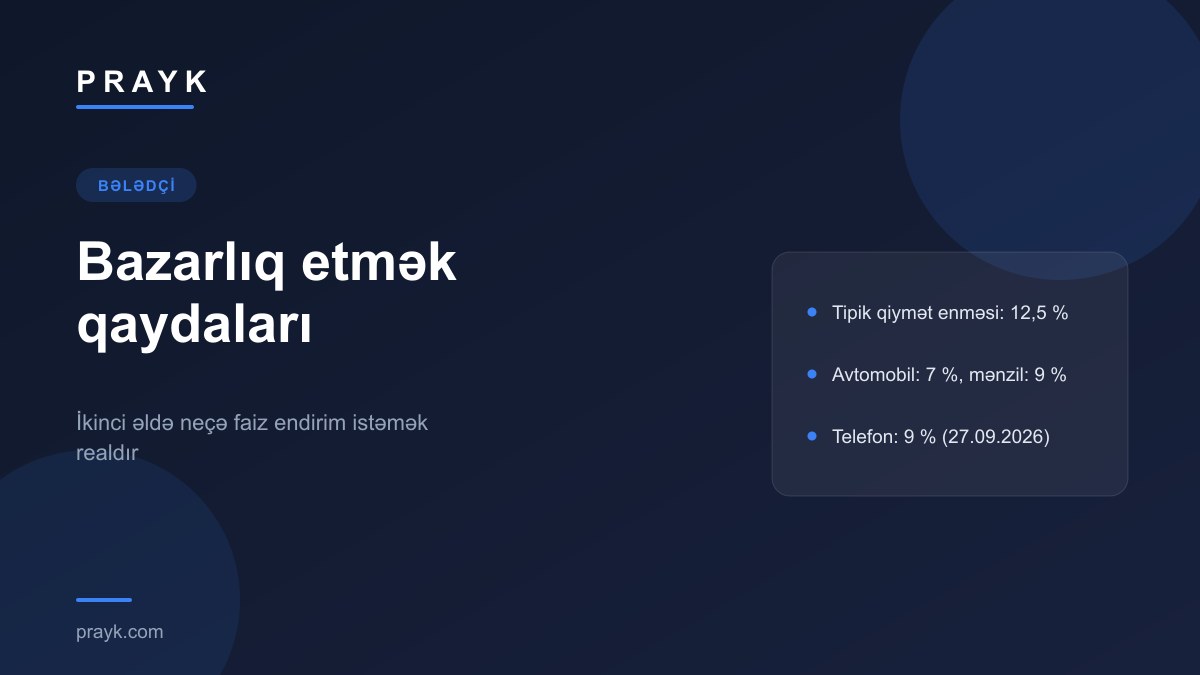
On second-hand deals the real room for haggling is usually 5–10%; a bigger discount is only likely when the price is above the market or the listing has been up for a long time. That is what sellers' own price cuts on Prayk show: on 27 September 2026, among the latest 300 price cuts the typical (median) discount was 12.5% — 7% for cars, 9% for flats for sale and 9% for smartphones. Below: how to find the market price, how much to offer and how much haggling room to build in as a seller.
Short answer: start by finding the item's market price (the median of similar listings). If the price is at market level, asking for 5–10% off is realistic; if it is above the market, build your offer around the median; if the listing has been unsold for a long time, you can push harder. As of 27 September 2026, 4,967 Prayk listings had a price cut in the last 7 days, and 61% of the cuts were smaller than 15%.
What should you know before you start haggling?
Haggling starts with the market price. The price of one listing tells you nothing on its own: you need to compare it with dozens of listings for the same model in the same condition. The key idea here is the median: the price in the middle when similar listings are sorted by price. Half the listings are cheaper and half are more expensive. Unlike the average, the median isn't thrown off by one or two absurd prices (such as a listing priced at "1 AZN").
- Market comparison on the listing page. When there are enough similar listings, Prayk shows how many percent the price is below or above the market asking price and how many listings the comparison is based on. More: price tools.
- The "Good deal" badge. It appears on the cards of listings priced below similar ones. How it is calculated: what the "Good deal" badge means.
- "Check a listing". The "Check a listing" report, opened from the Deal Score line on the listing page, shows where the price sits in the market, the price history (original price, how many times it changed) and the listing's age. If a listing has been up for a long time, the report flags it: a listing that hasn't sold for a while may leave room for negotiation.
- For cars and flats, the "What's my car worth?" and "What's my home worth?" tools give an estimate based on similar listings.
Remember that all of these figures are asking prices — what sellers want. The actual deal price is usually a little lower, and that gap is your room to haggle.
How much do sellers cut prices themselves?
Sellers' own behaviour is the best guide to realistic discounts. Prayk's price drops feed compares each listing's previous and current price. On 27 September 2026 the feed held 4,967 listings whose price fell in the last 7 days: Goods — 3,439, Cars — 653, Real estate — 386, Smartphones — 374, Animals — 83. The typical size of the latest cuts by segment:
| Segment | Cuts measured | Median discount | Middle half of cuts | Typical discount amount |
|---|---|---|---|---|
| All sections | 300 | 12.5% | 7–20% | 30 AZN |
| Cars (vehicles only) | 60 | 7% | 6–11% | 700 AZN |
| Property for sale | 84 | 9% | 7–12% | 6,000 AZN |
| Property for rent | 36 | 8% | 7–12% | 50 AZN |
| Smartphones | 60 | 9% | 7–15% | 105 AZN |
The takeaway is simple: on expensive items sellers give up little in percentage terms but a lot in money. The median price of the measured cars after the cut was about 8,000 AZN, and of property for sale 55,000 AZN; at that level 7–9% means hundreds or thousands of manats. On cheap items (clothes, household goods) the percentage is higher but the amount is small: across all sections the typical cut was just 30 AZN. 15% of cuts were larger than 30% — usually listings whose original price was clearly set too high.
What discount is realistic to ask for?
The figures above are discounts sellers make on their own, without waiting for a buyer. Based on them, a practical rule of thumb:
- The price is at the market median — ask for 5–10%. For a car or a flat 5–7% is more realistic; for a cheap item 10–15% may work.
- The price is above the market — justify the discount with the median rather than a percentage: "similar listings go for about this much". When a listing's price is at least 5% above the market median, Prayk itself shows a rounded offer amount close to the median, and the "Write an offer" button opens a ready-made message to the seller.
- The price is already below the market (it has the "Good deal" badge) — asking for a big discount risks losing the item. Ask for a small concession or an extra (delivery, an accessory).
- The listing has been unsold for a long time or its price has already been cut several times — the seller is more ready to agree. Check the price history in the listing's "Check a listing" report.
Don't offer half price: it offends the seller and ends the conversation. And an item that is far too cheap should raise questions in itself — in that case see our guide to scam schemes.
How should you haggle?
- Inspect the item first, then talk price. Scratches, battery health, mileage, signs of repair — every real flaw is grounds for a discount. With a flawless item, the market is your only argument.
- Name a specific figure. "What's your best price?" nudges the seller to repeat the listed price. "If you'll take 850 AZN, I'll pick it up today" works better.
- Have a reason. "The median price for this model is 800 AZN", "the battery is at 78%, I'll have to replace it" — a reason with a number that can be checked.
- Speed and readiness to pay count too. "I can come and collect it today" is worth an extra concession to the seller.
- Agree before you meet. Settle the price in the chat so there are no surprises on the spot, but pay only after checking the item.
- Stay polite. Thank the seller when they say no — a week later they may write back and agree.
How much haggling room should a seller build in?
If you are selling, expect buyers to ask for a discount. Listing 5–10% above the market median leaves room to haggle, but going higher risks buyers not opening the listing at all: they also see the "above market" note in the comparison. More on pricing: the market price indicator and 10 strategies to sell fast.
- Set your minimum price in advance and don't go below it.
- If your listing says the price is negotiable, be ready to give a few percent.
- If you cut the price, do it once and noticeably: on Prayk a cut smaller than 5% doesn't enter the price drops feed, while a noticeable cut shows up there and triggers a "price dropped" notification for people who saved the listing.
Frequently asked questions
What discount is normal to ask for on a used item?
If the price is at market level, 5–10%. On 27 September 2026 the median of sellers' own price cuts on Prayk was 7% for cars, 9% for flats for sale and 9% for smartphones — a discount requested by a buyer is realistic within roughly the same range.
Where can I find the market price?
In the market comparison on the listing page (how many percent the price differs from similar listings' asking prices), in the "Check a listing" report opened from the listing page, and for cars and flats in the "What's my car worth?" and "What's my home worth?" tools.
How does haggling work when buying a car?
With cars the concession is small in percent but large in money: among the measured car listings the typical cut was 7%, or about 700 AZN. Justify your discount with flaws found during an inspection and with the median for cars of the same year and mileage.
The seller wrote "final price". Should I still make an offer?
You can, politely — especially if the price is above the market or the listing has been up for a long time. But if the price is already below the market, there's no point asking for a big discount.
Is it worth waiting for the price to drop?
Sometimes. If you add the listing to your favourites, you'll be notified when the price falls by at least 5%; in the listing's "Check a listing" report you can also set your own target price. The risk is that someone else buys it in the meantime. More: guide to tracking price drops.
Sources and methodology
The figures come from the "Price drops" feed of Prayk's public API on 27 September 2026. The feed compares each listing's previous effective price with its current price; cuts smaller than 5%, larger than 60% (usually a typo) or under 5 AZN, and listings no longer published, are excluded. Section counts cover the last 7 days. Segment statistics are based on the most recent cuts in each segment: all sections — 300 cuts; from the Cars section, 60 vehicle listings with a model year in the title (parts excluded); 120 cuts from the Real estate section split by title into sale (84) and rent/lease (36); smartphones — 60 cuts. The median is the middle value when cuts are sorted by percentage; the "middle half" column spans the 25th to 75th percentiles; the amount median covers listings priced in AZN. These are asking-price reductions by sellers, not actual deal prices; the final price agreed after haggling is not recorded on the platform.