Choosing children’s clothes: size chart by height and quality
Choose children’s clothes by height, not age: numbers such as “92”, “104” or “116” on European labels show the child’s height in centimetres that the garment is made for. Measure your child and allow one size (6 cm) of room — that usually lasts a season. For fabric, the key rule is that the layer touching the skin should be natural and breathable; for second-hand items, checking the seams, zips and wear spots is usually enough.
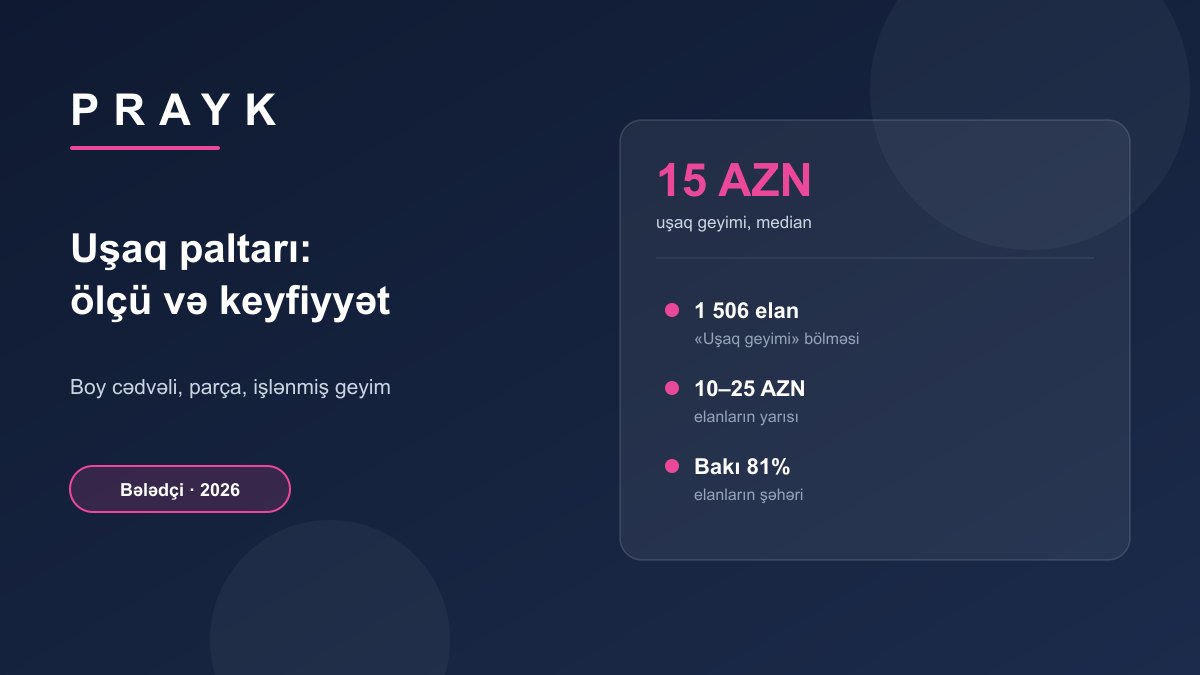
Short answer: the label size (50–164) is the child’s height in centimetres; sizes go up in 6 cm steps, and one size of room is enough. As of 22 September 2026, Prayk’s Children’s clothing section has 1,506 listings; the median price of the latest 300 is 15 AZN (half cost 10–25 AZN), and 81% of listings are in Baku. Newborn clothing is cheaper — median 10 AZN.
How do you read children’s clothing sizes?
Children’s clothes sold in Azerbaijan use three systems. European sizes (86, 98, 110, etc.) equal the child’s height and are the most precise. Age labels (“2–3 years”, “18–24 months”) assume average height for that age, so they can mislead if your child is taller or shorter than peers. US sizes (2T, 3T, 4T; “T” stands for toddler) roughly follow age, but vary a lot between brands.
On Prayk, sellers often give the size as an age («Jaket, Uniseks, 1–2 yaş»). In that case, ask for a photo of the label or the length in centimetres — the same “4–5 years” can differ by a full size between brands.
Children’s clothing size chart by age and height
The chart follows the European height-based sizing system. If your child’s height has reached or passed the number on the label, go for the next size.
| Age (approx.) | Child’s height | Label size |
|---|---|---|
| 0–1 month | 50–56 cm | 50 / 56 |
| 1–3 months | 57–62 cm | 62 |
| 3–6 months | 63–68 cm | 68 |
| 6–9 months | 69–74 cm | 74 |
| 9–12 months | 75–80 cm | 80 |
| 12–18 months | 81–86 cm | 86 |
| 18–24 months | 87–92 cm | 92 |
| 2–3 years | 93–98 cm | 98 |
| 3–4 years | 99–104 cm | 104 |
| 4–5 years | 105–110 cm | 110 |
| 5–6 years | 111–116 cm | 116 |
| 6–7 years | 117–122 cm | 122 |
| 7–8 years | 123–128 cm | 128 |
| 8–9 years | 129–134 cm | 134 |
| 9–10 years | 135–140 cm | 140 |
| 10–11 years | 141–146 cm | 146 |
| 11–12 years | 147–152 cm | 152 |
| 12–13 years | 153–158 cm | 158 |
| 13–14 years | 159–164 cm | 164 |
How to measure correctly at home
- Height: have your child stand barefoot with heels against a wall; place a book flat on the head, mark the wall and measure from the floor.
- Chest and waist: wrap a tape measure loosely at armpit level and at the navel — you need these for outerwear and trousers.
- Compare with a garment that fits: lay a well-fitting T-shirt or trousers flat, measure length from shoulder to hem and width under the arms, and ask the seller for the same measurements.
How much bigger can you buy?
One size (6 cm) of room is normal. Buy winter outerwear one size up to fit a jumper and warm layers underneath. Two sizes up means sleeves cover the hands and trouser legs tangle — uncomfortable, and your child may trip. Babies grow very fast in the first months, so buy only a few items in sizes 50–56.
How do you recognise quality fabric?
For the layer next to the skin (underwear, bodysuits, T-shirts, pyjamas), choose natural, breathable fabric; for outer layers, durability matters more.
| Fabric | Pros | Watch out for | Best for |
|---|---|---|---|
| 100% cotton | Breathable, soft, gentle on skin | May shrink slightly in the first wash; creases easily | Bodysuits, underwear, T-shirts, summer clothes |
| Cotton + elastane (2–5%) | Stretches, keeps its shape | The more elastane, the less breathable | Leggings, jeans, slim trousers |
| Cotton + polyester | Durable, crease-resistant, dries fast | Prone to pilling | School uniforms, tracksuits, hoodies |
| Wool and wool blends | Keeps warmth well | Can itch — layer cotton underneath; gentle wash | Winter jumpers, hats |
| Fleece | Light and warm, dries fast | Synthetic, less breathable, static | Outer layer, loungewear |
| Linen | Cool, very breathable | Creases quickly | Hot summer days |
5 quick checks before you buy
- Composition label: read the percentages and care symbols; if there is no label, ask the seller.
- Seams: turn the item inside out — edges should be finished evenly with no loose threads; gently pull the underarm and crotch seams.
- Colour: rub with a damp white wipe; if dye comes off, wash the item separately the first time.
- Smell: always wash clothes with a sharp chemical smell before your child wears them.
- Certification: the “STANDARD 100 by OEKO-TEX” label means the fabric was tested for harmful substances; product class I sets the strictest limits, for children up to 3 years. You can check the certificate number on the official OEKO-TEX website.
Safety in young children’s clothing: what to look for
- Hood and neck cords. European standard EN 14682 prohibits drawstrings and hanging cords in the hood and neck area of clothing for children under 7 — they can snag. If a second-hand item has one, remove it.
- Small parts. On clothes for children under 3, buttons, beads, sequins and glued decorations must be firmly attached; give them a tug to check.
- Elastics. Waist, cuff and sock elastics should not leave deep marks on the skin.
- Zips. A fabric guard at the top that protects the chin is a good sign.
Second-hand children’s clothes: prices and checks
Children wear clothes only briefly, so the second-hand market is large and prices are low. Here is the picture on Prayk as of 22 September 2026 (median and range from the latest listings in each section, AZN only):
| Section | Listings | Median price | Middle half of listings |
|---|---|---|---|
| Children’s clothing (whole section) | 1,506 | 15 AZN | 10–25 AZN |
| For girls | 234 | 15 AZN | 8–30 AZN |
| For boys | 64 | 27 AZN | 17–59 AZN |
| Clothing for newborns | 78 | 10 AZN | 8–15 AZN |
| School uniform | 26 | 15 AZN | 10–30 AZN |
Of the 234 listings in the For girls section, 116 are dresses and sundresses — party dresses are often sold after one or two wears. The For boys section has a higher median because many recent listings are new branded items from shops. Of the 78 newborn clothing listings, 60 are rompers. The outerwear subsections hold just 5 listings, so look for jackets in the main Children’s clothing section.
Checklist for buying second-hand
- Ask for photos of the actual item, not catalogue pictures, and a photo of the label (size and composition).
- Ask for the length and underarm width in centimetres and compare with a similar garment at home.
- Check wear spots: knees, elbows, cuffs, collar; stains, holes and pilling lower the price.
- Test the zip, buttons and elastics.
- For winter wear, squeeze the filling (synthetic or down) — if it has clumped, the item won’t keep as warm.
- Walk away if you notice a damp or musty smell.
- After buying, wash and dry the item on the setting allowed on the label before your child wears it.
Bundles (“set for 1–2 years”) usually work out cheaper per item. To find the same model by photo, use image search; to find sellers nearby where you can check the size in person, use the map and Nearby feature. Browse Clothing for newborns, For girls, For boys, School uniform and Children’s footwear.
If you are selling children’s clothes
Wash and iron the item, photograph it in daylight on a plain background and show the label separately. Put the type, who it is for, the size and the age in the title, for example: “Jacket, boy, 116 (5–6 years)”. State any flaws openly so the buyer doesn’t back out over a stain they spot when you meet. More tips: how to write a good listing.
Frequently asked questions
What clothing size does a 3-year-old need?
On average, a 3-year-old wears size 98 (height 93–98 cm). But go by height rather than age: if your child is taller than 98 cm, choose 104.
What does size “110” mean on children’s clothes?
In the European system, “110” means the garment is made for a child about 105–110 cm tall, usually 4–5 years old. Sizes go up in 6 cm steps: 104, 110, 116 and so on.
How many sizes bigger can you buy children’s clothes?
One size (6 cm) of room is normal and usually lasts a season. Winter outerwear can be one size up to fit layers underneath. Clothes two sizes too big restrict movement and can make a child trip.
Is it safe to buy second-hand children’s clothes?
If the item is clean, intact and odour-free, buying second-hand children’s clothes is common practice. Check the seams, zip and buttons, remove hood and neck cords on clothes for young children, and wash everything before use.
How much do children’s clothes cost on Prayk?
As of 22 September 2026, Prayk’s Children’s clothing section has 1,506 listings; the median price of the latest 300 is 15 AZN, with half between 10 and 25 AZN. The median for newborn clothing is 10 AZN, and for school uniforms 15 AZN.
Sources and methodology
Listing counts and prices come from Prayk’s public catalogue on 22 September 2026: Children’s clothing (1,506 listings, median from the latest 300), For girls (234), For boys (64), Clothing for newborns (78), School uniform (26) and the girls’ and boys’ outerwear subsections (5 listings). Medians and ranges (the middle half of listings, p25–p75) use AZN prices only. The size chart follows the widely used European height-based sizing system (EN 13402); a specific brand’s chart may differ by one size. The rule on cords in children’s clothing comes from European standard EN 14682. On fabric certification: STANDARD 100 by OEKO-TEX. This article is general information; if your child shows skin irritation or signs of allergy, consult a doctor.